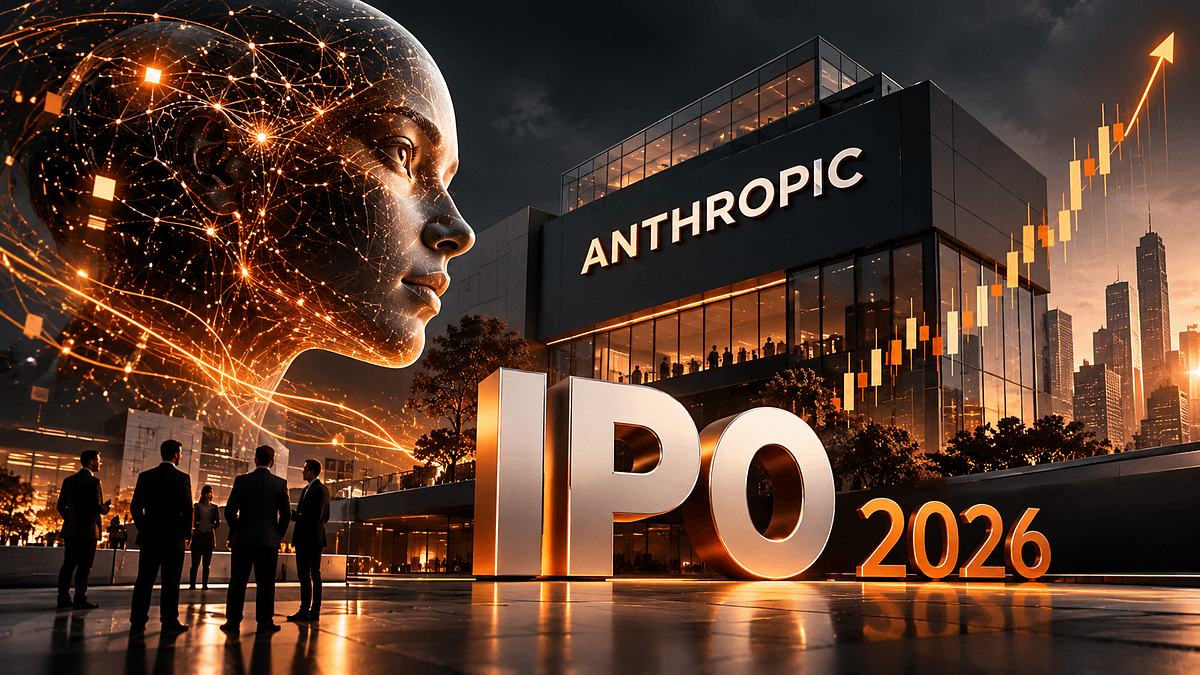
The company behind Claude AI is going public. On October 26, 2026, Anthropic filed its S-1 with the SEC, setting up what could be the largest technology IPO in history and a defining test of how Wall Street values the artificial intelligence boom.
What Happened: Anthropic Files Its IPO Paperwork
Anthropic, PBC publicly submitted its Form S-1 registration statement to the U.S. Securities and Exchange Commission on Monday, October 26, 2026. For the first time, the public can see audited numbers for one of the most closely watched private companies in the world: its revenue, losses, compute commitments and governance structure.
According to the filing and coverage from CNBC, CNN and CBS News, Anthropic's Class A shares are expected to list on the Nasdaq under the ticker "ANT". Morgan Stanley, Goldman Sachs and JPMorgan Chase were reported in July as the lead underwriters. The S-1 does not yet include a share price, the number of shares on offer or a target valuation. Those will be set after the investor roadshow.
Why it matters: Reports suggest the offering could raise up to $100 billion, which would make it bigger than SpaceX's June 2026 listing and the largest IPO on record. Rival OpenAI has filed confidentially but has said its own debut is unlikely before 2027, so Anthropic will be the first frontier AI lab to face public-market investors.
Anthropic IPO 2026 at a Glance
- Expected Nasdaq ticker
- ANT
- Expected Nasdaq ticker
- Revenue, H1 2026
- $16.3B
- Revenue, H1 2026
- YoY revenue growth (H1)
- ~1,300%
- YoY revenue growth (H1)
- Last private valuation (May 2026)
- $965B
- Last private valuation (May 2026)
- Net loss, H1 2026
- −$80.7B
- Net loss, H1 2026
- Compute & infrastructure commitments
- $542–567B
- Compute & infrastructure commitments
Figures from Anthropic's S-1 (filed Oct 26, 2026) and news coverage. Final IPO terms have not been set.
Who Is Anthropic, the Claude AI Company?
Anthropic was founded in 2021 by seven former OpenAI researchers, including siblings Dario Amodei (CEO) and Daniela Amodei (President). It is organized as a public benefit corporation (PBC), which means its directors are legally allowed to weigh its stated mission, the safe development of AI, alongside shareholder returns.
Its main product is Claude, a family of large language models sold through:
🧑💻 Claude Code
An agentic coding tool that became one of the fastest-growing developer products in software history.
🏢 Enterprise & API
Businesses build on Claude through Anthropic's API and cloud partners such as AWS and Google Cloud.
💬 Claude apps
Consumer and team subscriptions for Claude on web, desktop and mobile.
Most of Anthropic's revenue comes from businesses and developers rather than consumers. Investors tend to value that mix more highly because enterprise contracts are larger and less likely to be cancelled.
Revenue Growth: The Numbers Behind the Hype
The headline figure in the S-1 is growth. Anthropic reported $16.3 billion in revenue for the first six months of 2026, up roughly 1,300% year over year. Coverage of the filing also highlights net revenue retention of about 900%, meaning existing customers are spending many times more than they did a year earlier.
Its annualized revenue run-rate has grown just as quickly. Forbes, citing the filing, puts the third-quarter run-rate at about $67 billion, up from a run-rate in the single-digit billions at the end of 2025.
| Period | Revenue metric | What it shows |
|---|---|---|
| End of 2025 | Single-digit billions run-rate | Claude Code and enterprise API take off |
| H1 2026 | $16.3B revenue (≈1,300% YoY) | Hyper-growth confirmed in audited numbers |
| Q3 2026 | ≈$67B annualized run-rate | On pace to rival the largest software companies |
For context, SaaStr estimates that by the end of 2026 Anthropic could out-earn every public software company except Microsoft. That pace of artificial intelligence market growth is the main reason investors are interested, and also why the valuation debate is so heated.
The $80.7 Billion Loss and AI Infrastructure Costs
The headline loss figure needs some explanation. Anthropic reported a net loss of $80.7 billion for the six months ended June 30, 2026. About $72.4 billion of that was non-cash fair-value changes on convertible notes, derivative liabilities and SAFEs. When a company's value rises sharply, the accounting value of those instruments rises too, and the increase is recorded as a loss.
✅ The Bull Reading
Most of the loss is an accounting effect of Anthropic's own rising valuation. Reports say the company posted an operating profit of over $1 billion in Q2 2026.
⚠️ The Bear Reading
Anthropic has committed to $542–567 billion in compute and infrastructure. That is a huge long-term bill that revenue has to keep growing to cover.
Infrastructure spending is the central question for AI industry investment as a whole. Training and serving frontier models requires enormous amounts of chips, data centers and electricity. Anthropic's S-1 is one of the first public documents to show how large those commitments are for a single AI lab.
Anthropic Valuation: From Startup to Near-Trillion
Anthropic's AI startup valuation rose faster than almost any private company before it. Its May 2026 Series H, a reported $65 billion round, valued the company at about $965 billion post-money. At a run-rate of roughly $65 billion, that works out to about 15 times annualized revenue.
Media estimates for the IPO valuation range from above $1 trillion to nearly $2 trillion. Reuters has also reported that some existing and prospective investors are considering a lower valuation after reading the full financial disclosures. The final number will depend on the roadshow, the size of the order book and the state of the market in November.
📊 How to read the multiple
Mature software companies often trade at single-digit to low-teens revenue multiples. A higher multiple for Anthropic is a bet that very fast growth will continue and that compute costs per dollar of revenue will fall over time. If either assumption weakens, the stock is likely to be repriced.
Who Controls Anthropic After the Stock Market Listing?
The Anthropic stock market listing comes with one of the most complex governance setups ever brought to public markets. The S-1 describes five classes of stock:
- Class ASold in the IPO and traded on Nasdaq as ANT, with one vote per share.
- Class FHeld by a Founder LLC owned by the seven co-founders, carrying 50.1% of general voting power.
- Class TA single share held by the Long-Term Benefit Trust, which elects the directors who form a board majority.
- Class NHeld mainly by strategic partners such as Amazon and Google, with economic rights but no votes.
Fortune compares this setup to the founder-control models used by Mark Zuckerberg at Meta and by The New York Times. In practice, public shareholders get economic exposure to Anthropic but little say over how it is run. Anthropic presents this as protection for its safety mission. Governance-focused investors see it as a risk.
Key Risks in the Anthropic IPO Filing
Dispute with the U.S. Department of Defense
Anthropic declined a Pentagon demand for an "all lawful uses" clause, and the Department of Defense designated it a supply-chain risk. A federal appeals court upheld that designation in September 2026, although a district court blocked broader government-wide bans. The S-1 warns the dispute could cause "material revenue losses or business disruptions."
Massive compute obligations
More than half a trillion dollars in infrastructure commitments must be funded by sustained revenue growth and continued access to capital.
Intense competition
OpenAI, Google, Meta, xAI and open-weight model developers are all competing for the same enterprise and developer budgets, which puts pressure on pricing.
Concentrated control
Founder and trust voting power limits how much influence public shareholders have over strategy and the board.
AI safety and regulation
New AI rules in the U.S., EU and elsewhere could change how models are trained, deployed and sold.
What the Anthropic IPO Means for the AI Market
CNBC describes the listing as having a potential "trickle-down effect" from Wall Street to Silicon Valley. How ANT trades is likely to affect the wider tech sector in several ways:
For AI Startups
- • Gives public-market benchmarks for private AI valuations
- • A strong debut could reopen the IPO window for other AI companies
- • A weak debut could tighten AI funding, which has already been slowing
For Big Tech & Infrastructure
- • Amazon and Google hold large strategic stakes
- • Chip, cloud and data-center suppliers benefit from its compute spending
- • Raises pressure on OpenAI ahead of its own listing
In short, the Anthropic IPO is a referendum on whether the business model of frontier AI (very high growth funded by very high spending) can hold up under the scrutiny of public markets.
Anthropic Investor Outlook: What to Watch Next
- 1SEC review and amended S-1s: Updated filings will add the price range and share count.
- 2Roadshow demand: Strong institutional demand usually leads to upsizing or a higher price range.
- 3Pricing date: Pricing is currently expected around mid-November 2026, subject to market conditions.
- 4Q3 results: Investors will look for proof that the run-rate is turning into recognized revenue and steady operating margins.
- 5Pentagon litigation: Any settlement or new ruling could change the risk profile quickly.
- 6Lock-up expiry: Early investors and employees usually cannot sell for about 180 days, after which supply of shares can rise.
💡 Key Takeaway
Anthropic is going public with very fast revenue growth, very large compute obligations and a governance structure built to protect its mission. For anyone following Claude AI company news or the wider AI economy, the ANT listing will be one of the most important market events of 2026.
Disclaimer: This article is for informational and educational purposes only and is not financial advice. IPO details, including pricing and dates, may change. Always do your own research or consult a licensed financial advisor before investing.
Frequently Asked Questions About the Anthropic IPO
Has Anthropic filed for an IPO in 2026?
+
Yes. Anthropic, PBC publicly filed its S-1 registration statement with the U.S. Securities and Exchange Commission on October 26, 2026. The filing is the formal first step before shares can be sold to the public.
What will Anthropic's stock ticker be?
+
According to the filing and news coverage, Anthropic's Class A shares are expected to trade on the Nasdaq under the ticker symbol ANT.
When is the Anthropic IPO date?
+
No final date has been set. Reports suggest pricing could come in mid-November 2026 after an investor roadshow, but the timing depends on SEC review and market conditions.
How much is Anthropic worth?
+
Anthropic was valued at about $965 billion after its Series H funding round in May 2026. Media reports suggest the IPO could value the company at well above $1 trillion, with some estimates approaching $2 trillion, but the final valuation will only be known when shares are priced.
Is Anthropic profitable?
+
Not on a net basis. The S-1 reports a net loss of $80.7 billion for the first half of 2026, but about $72.4 billion of that came from non-cash fair-value changes on convertible notes, derivatives and SAFEs. Coverage of the filing notes that the company posted an operating profit of over $1 billion in the second quarter.
Can retail investors buy Anthropic stock?
+
Once the shares begin trading on the Nasdaq, retail investors should be able to buy them through ordinary brokerage accounts. Allocation at the IPO price itself usually goes mostly to institutional investors, although some brokers offer limited IPO access.
Who controls Anthropic after the IPO?
+
Public Class A shareholders get one vote per share, but control stays concentrated. A Founder LLC owned by the seven co-founders holds 50.1% of general voting power, and the Long-Term Benefit Trust elects the Class T directors, who form a board majority.