
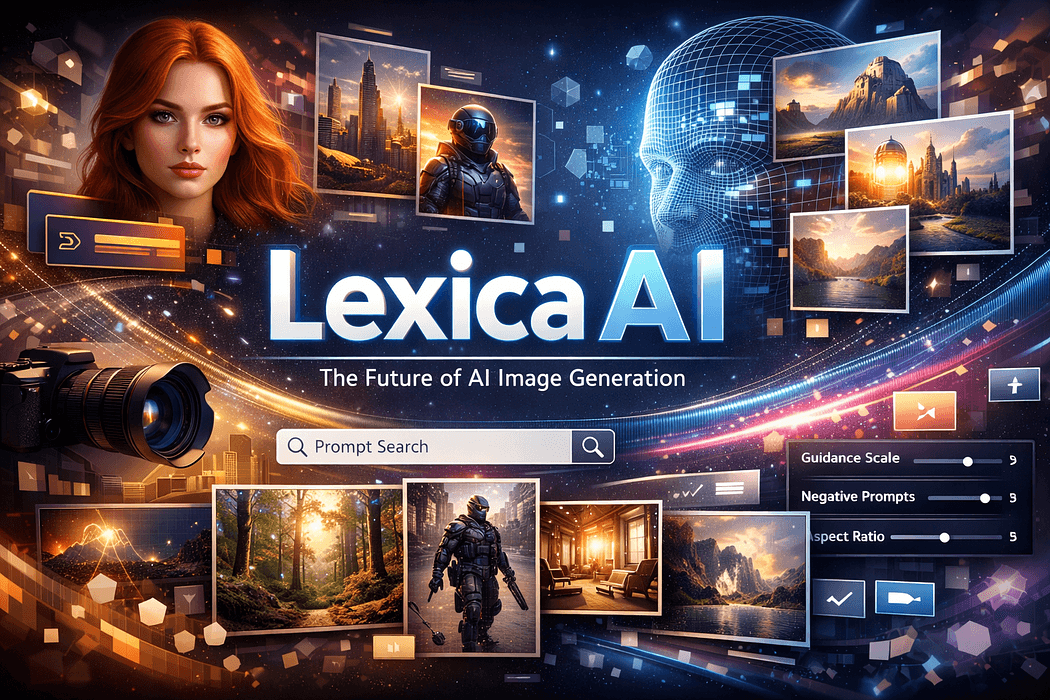
The explosion of AI image generation tools in recent years has created a crowded marketplace where most platforms compete on similar capabilities using similar underlying models. Lexica AI has carved out a distinctive position by combining a powerful proprietary diffusion model with something most competitors lack: a comprehensive prompt search engine built from millions of existing generations. This dual approach, generation capability paired with discovery infrastructure, makes Lexica particularly valuable for creators who want both to produce original images and to understand what prompting strategies actually work in practice. For designers, marketers, and digital artists working at the intersection of creativity and efficiency, Lexica represents a mature option worth serious consideration.
Lexica AI is an AI image generation platform built around two core components. The first is Lexica Aperture, a proprietary text-to-image diffusion model trained to produce high-quality, aesthetically refined images with particular strength in photorealistic rendering and artistic coherence. The second is the Lexica prompt search engine, a database containing millions of AI-generated images along with the exact prompts and settings used to create them.
This combination addresses a persistent challenge in AI image generation: understanding what prompts produce which results. Most platforms generate images but provide no systematic way to learn from others' successful prompts. Lexica inverts this by making prompt discovery a first-class feature, allowing users to search by style, subject, or visual characteristics to find reference examples before creating their own variations.
The platform operates as both a standalone image generator and a learning resource, making it particularly suited to users who want to develop prompting expertise rather than relying solely on trial and error.
The Lexica AI image generator centers on several capabilities that distinguish it from both open-source alternatives and commercial competitors. The Aperture v4 model, the latest generation of Lexica's proprietary diffusion architecture, produces images with notable improvements in prompt adherence, compositional coherence, and rendering quality compared to earlier versions. The model has been trained with an emphasis on producing outputs that require minimal post-processing for professional use.
The prompt search engine allows users to enter keywords, upload reference images, or describe desired aesthetics to discover existing generations that match their intent. Each result displays the full prompt, negative prompts, guidance scale, and other generation parameters, effectively reverse-engineering successful image creation strategies. This transparency accelerates the learning curve significantly compared to platforms where parameter choices remain opaque.
Advanced generation controls provide granular adjustment of image dimensions, guidance scale, negative prompts, and seed values. These parameters allow experienced users to fine-tune outputs precisely while remaining accessible enough for intermediate users to experiment productively. The platform supports custom aspect ratios and resolutions up to higher limits than many competitors, making it viable for print and high-resolution digital applications.
The image editing and variation features enable users to iterate on existing generations through inpainting, outpainting, and controlled regeneration of specific regions. This refinement capability is essential for professional workflows where initial generations rarely match final requirements exactly.
Understanding the technical foundation helps contextualize Lexica's capabilities and limitations. Diffusion models work by learning to reverse a gradual noising process, essentially training a neural network to remove noise from increasingly degraded images until clear, coherent visuals emerge. The text conditioning mechanism guides this denoising toward images that match the input prompt's semantic content.
Lexica Aperture has been trained on a curated dataset with particular attention to aesthetic quality, prompt-image alignment, and compositional principles. This curation bias means the model tends toward visually polished, artistically coherent outputs but may struggle with highly technical, diagrammatic, or deliberately unconventional visual styles that fall outside its training distribution.
The model architecture incorporates advances from the broader diffusion model research community while adding proprietary enhancements focused on prompt understanding, anatomical accuracy in figure generation, and lighting consistency. These improvements manifest in practice as images that require fewer regenerations to achieve usable results.
Marketing and advertising teams use Lexica AI for rapid concept visualization, social media content creation, and campaign asset development. The ability to search existing prompts for similar concepts accelerates briefing and iteration cycles significantly. Teams can identify effective prompting patterns for their brand aesthetic and replicate them systematically across content production.
Product designers and UI/UX professionals leverage Lexica for mood boarding, interface mockups, and conceptual exploration. The high-resolution output and photorealistic rendering capabilities make it particularly valuable for presentations and client communications where visual fidelity matters. The prompt search feature helps teams establish consistent visual languages across projects by referencing successful parameter combinations.
Editorial and publishing workflows incorporate Lexica for article illustrations, book covers, and digital publication visuals. The platform's strength in compositional coherence and aesthetic refinement produces images that integrate naturally into professional editorial contexts without extensive post-processing.
Independent creators including digital artists, content creators, and social media influencers use Lexica for portfolio development, channel branding, and content monetization. The combination of generation capability and prompt discovery reduces the technical barrier to producing commercially viable visual assets.
Educational and research contexts leverage the prompt database as a teaching tool for understanding how text-to-image models interpret language and visual concepts. The transparency of parameters makes Lexica valuable for courses and workshops focused on AI art generation techniques.
The Lexica vs Midjourney comparison reveals different philosophical approaches. Midjourney emphasizes artistic interpretation and stylistic coherence, often producing images with distinctive aesthetic signatures that users recognize as "Midjourney style." Lexica prioritizes prompt adherence and photorealistic rendering, producing outputs that feel more neutral and adaptable to various use cases. Midjourney operates through Discord, which creates community engagement but adds workflow friction. Lexica's web interface provides more direct generation without social platform dependencies.
The Lexica vs DALL-E comparison highlights infrastructure and capability trade-offs. DALL-E 3, integrated into ChatGPT and Microsoft platforms, benefits from conversational prompt refinement and enterprise integration. Lexica provides more granular generation controls and the unique prompt search capability but lacks the conversational scaffolding that helps non-technical users. DALL-E's safety filtering is more restrictive, which improves content moderation but limits some creative applications. Lexica's moderation is present but less constraining for professional use cases.
Stable Diffusion represents the open-source alternative that powers many competing platforms. Lexica Aperture is built on similar foundational technology but trained on proprietary datasets with commercial optimization. Users who need maximum control and customization may prefer running Stable Diffusion locally. Users who prioritize convenience, curated quality, and prompt discovery infrastructure will find Lexica's integrated platform more productive.
Successful Lexica AI art generation relies on understanding how the model interprets natural language descriptions. Prompts should be specific about subject, style, lighting, composition, and technical execution. A weak prompt like "a forest" produces generic outputs. A stronger prompt specifies "a dense redwood forest at golden hour, shafts of sunlight through morning mist, wide-angle landscape photography, cinematic lighting, high detail."
Style references work particularly well with Lexica. Including phrases like "in the style of [artist]," "photographed with [camera/lens]," or "[artistic movement]" helps anchor the aesthetic direction. The model responds effectively to photography terminology including focal length, depth of field, and lighting setup descriptions.
Negative prompts, specifying what to exclude, are essential for consistent results. Common negative prompt terms include "blurry," "distorted," "low quality," "artifacts," "watermark," and any specific elements that repeatedly appear undesired in generations. Building a personal negative prompt library accelerates workflow significantly.
Guidance scale adjustment controls how closely the model follows the prompt versus allowing creative interpretation. Higher values (12-20) produce images that match prompts more literally. Lower values (7-11) allow more artistic liberty. Finding the optimal range for your use case requires experimentation but creates more consistent results once established.
Marketing professionals and brand designers working under tight timelines benefit from Lexica's combination of quality output and prompt discovery. The ability to systematically generate on-brand visuals without photographer or illustrator dependencies makes it valuable for campaign production and content marketing at scale.
Freelance designers and digital artists use Lexica as both a production tool and a creative research platform. The prompt database functions as a continuously updated reference library for understanding effective visual communication strategies across styles and subjects.
Small businesses and solopreneurs without dedicated design resources leverage Lexica to produce professional-quality visuals for websites, social media, marketing materials, and product mockups. The learning curve is manageable for non-technical users willing to invest time understanding prompting fundamentals.
Agencies and creative studios integrate Lexica into conceptualization and pitching workflows. The speed of iteration allows teams to explore more creative directions within client timelines, improving proposal quality while reducing speculative work hours.
Lexica AI performs best within the visual and stylistic bounds of its training data. Highly technical diagrams, specialized scientific visualizations, or deliberately unconventional aesthetics may produce inconsistent results. Users with needs outside mainstream commercial and artistic image categories should test extensively before committing to production workflows.
Text rendering within images remains inconsistent across all diffusion models including Lexica. Projects requiring legible text should plan for post-processing or composite workflows rather than expecting reliable direct generation.
The platform's commercial licensing terms permit broad use but require verification for specific publishing contexts. Users should review current terms before using Lexica-generated images in products for resale, editorial contexts, or client deliverables where copyright clarity matters.
Prompt search results reflect the aggregate aesthetic preferences and prompting conventions of the user base. This creates discovery bias toward popular styles and subjects, potentially making less common visual approaches harder to reference. Users pushing creative boundaries should balance database reference with original experimentation.
Beginning with Lexica effectively means investing time in the prompt database before generating original images. Search for subjects similar to your intended output, study the prompts that produced results you admire, and note patterns in structure, specificity, and stylistic references.
Start with modified versions of successful prompts rather than writing from scratch. Identify a reference image close to your intent, copy its prompt, and adjust the subject or style details while maintaining the structural approach. This technique accelerates learning and produces usable results earlier in your experimentation.
Build a personal prompt library documenting successful parameters for your specific use cases. Record what guidance scales, negative prompts, and structural patterns work consistently for your needs. This documentation becomes increasingly valuable as your generation volume grows.
Experiment systematically by changing one variable at a time. Adjust guidance scale independently from prompt wording, test negative prompt variations separately from positive prompt changes. This methodical approach builds intuition about how parameters interact.
Lexica AI distinguishes itself in the competitive AI image generation market through the integration of powerful generation capabilities with comprehensive prompt discovery infrastructure. The Aperture diffusion model produces commercially viable images with particular strength in photorealistic rendering and aesthetic coherence. The prompt search engine provides transparency and learning resources that most competitors lack. For marketing professionals, designers, and digital creators who need both production capability and systematic improvement in their prompting expertise, Lexica offers a mature platform worth serious evaluation. While it has the typical limitations of diffusion models and works best within established aesthetic frameworks, its combination of generation quality and prompt intelligence makes it a practical choice for professional visual content production in 2026.