
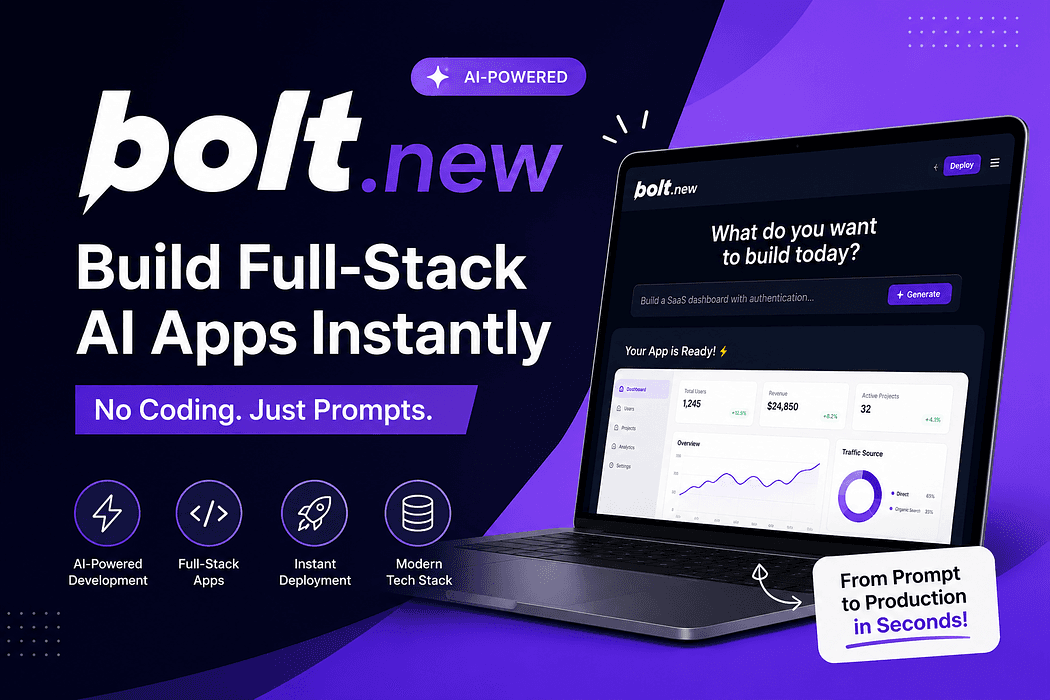
The barrier between having an idea and shipping a working application has never been lower. Bolt.new AI app builder sits at the centre of that shift — a browser-based platform that converts a plain-language prompt into a deployable, full-stack web application within minutes. For product managers, founders, and developers looking to compress weeks of setup work into a single session, Bolt warrants serious evaluation. This review covers what the platform actually does, how it performs across different use cases, where it falls short, and who will get the most value from it in 2026.
Bolt.new is a browser-based app builder that turns plain language prompts into fully functional applications. You describe what you want to build, and it generates the front end, back end, database, and API endpoints in minutes. The platform runs through a web-based IDE rather than requiring local installation, which eliminates the environment setup that typically consumes hours of developer time before a single line of product code is written.
Built as a StackBlitz product — a browser-based IDE — it integrates AI agents with a live runtime environment to handle everything from frontend UI to backend logic and database setup. Bolt AI is powered by Claude and other major LLMs, and supports modern frameworks such as React, Node.js, and PostgreSQL. The platform is also open-source.
The workflow is straightforward. A developer or non-technical builder describes the application they want, and Bolt scaffolds it in real time. From that point, customization happens across three layers: prompt-based changes, a visual preview editor, and direct code access inside the browser IDE. This layered approach means both non-coders and experienced engineers can engage with the output at whatever depth they prefer.
In 2026, Bolt.new has been rolling out several upgrades focused on collaboration and design-to-code workflows. These include Team Templates to turn existing projects into reusable starters, editable Netlify URLs that allow URL changes without redeploying, an Opus model upgrade that lets users choose between lighter or deeper AI reasoning, Figma import to build from visual designs in real time, and in-app AI image editing.
Bolt automatically tests, refactors, and iterates, reducing errors so developers keep building instead of fixing. It handles projects 1,000 times larger than before, with improved built-in context management to handle complexity and keep projects running smoothly.
One standout feature is the Interaction Discussion Mode. This lets users pause building and brainstorm directly with the AI before making any real changes. Instead of writing code or commands, users can ask the AI for creative suggestions — how to refine layouts, improve button placement, or streamline user experience. The mode functions like chatting with a developer who offers design feedback before implementation.
On the deployment and integration side, one-click deployment to .bolt.host simplifies publishing, with built-in integrations for Supabase, Stripe, GitHub, Netlify, and Figma. The AI assists with authentication, database setup, and hosting configuration.
To illustrate what the Bolt.new AI app builder delivers in practice, consider a recipe tracking application. After creating an account, a builder can describe the app idea in specific terms: "Create a recipe tracking app where users can add and view recipes. Include a main page listing all recipes and individual pages for each recipe. The design should be modern and sleek." Bolt's enhance prompt feature then adds further detail to the initial description before generation begins.
From there, refinements are made through the chat interface — requesting a search bar to filter recipes, improved card design with visual elements, user ratings, meal planning functionality, or a shopping list generator based on selected recipes. The iteration continues until the app meets specific requirements.
This workflow compresses what would traditionally be a multi-day development task — database schema, API routes, UI components, authentication — into a single iterative session. For a React AI app builder capable of handling that full stack simultaneously, it represents a meaningful acceleration of the prototyping cycle.
Bolt.new is strongest when speed matters more than perfection. It shines in early-stage building, rapid experimentation, and situations where a working product is needed fast and refinement is secondary. Product managers can use it to test flows, validate features, and align stakeholders before engineering resources are committed.
Experienced developers can choose from a wide range of JavaScript frameworks, including React, Vue, Svelte, Next.js, and Astro. Beginners unfamiliar with programming languages or modern frameworks can browse non-developer categories like "Docs, Blogs, and Slides." That dual-track approach makes Bolt.new one of the more versatile AI developer tools in 2026, serving both ends of the technical spectrum within a single platform.
January 2026 benchmarks show a 40% improvement in build performance over 2024. Bolt has also powered over one million websites in partnership with Netlify and reached $40M ARR by March 2025, with StackBlitz raising $105.5 million in Series B funding at a valuation of approximately $700 million. These figures reflect genuine adoption rather than speculative hype.
Among vibe coding tools and full-stack AI development platforms, the two names that appear most frequently in comparison are Bolt.new and Cursor. Cursor is an AI-powered code editor that excels for developers who want AI assistance within their existing workflow. It is ideal for those who prefer more hands-on control over code while still benefiting from AI suggestions and automation. In practical terms, Cursor is an enhancement to a traditional development environment; Bolt.new is a replacement for one, at least in the early build stages.
Bolt, Lovable, and Replit use AI for production-ready code generation from natural language prompts, giving developers full access to modify, export, and deploy anywhere. This approach excels for technical users who want speed without sacrificing control. Bubble, by contrast, uses a visual drag-and-drop interface with proprietary logic, making it accessible to non-coders but creating platform dependency.
On pricing comparability, with 10 million or more tokens per month on every paid plan, Bolt offers a good amount of output roughly comparable to similar tools at the same price point. It also includes unique features that competitors have not introduced, such as an SEO booster and an in-app image generator.
The platform has meaningful constraints that professional users should understand before committing to it for production-grade work. Simple applications with three to five components generate functional code within minutes with minimal debugging. Once projects exceed fifteen to twenty components or require custom API integrations, context retention degrades noticeably. Token consumption accelerates during debugging cycles, often doubling initial estimates.
Bolt.new provides real-time logs, error detection, and an "Attempt Fix" mode for guided debugging. It resolves minor syntax issues effectively, but deeper framework conflicts or architectural inconsistencies can persist. Token consumption during repeated debugging cycles can increase costs.
The pricing model introduces its own unpredictability. Token usage is primarily related to syncing the project's file system to the AI — the larger the project, the more tokens used per message. Some users have reported opaque token consumption, making it difficult to predict monthly costs for complex projects. The free plan is weak and the learning curve is steeper compared to similar tools. The $25 per month Pro plan is the practical entry point for anyone building anything beyond a basic prototype.
Bolt.new AI app builder occupies a well-defined and genuinely useful position in the 2026 AI coding platform landscape. Smart teams use strategic allocation: Bolt for rapid prototyping, developers for core product, and other tools for internal operations that do not require custom code. That framing captures its value accurately — it is not a replacement for a senior engineering team on a complex product, but it is an exceptionally capable accelerator for the earliest and most expensive phase of any build: getting from zero to something testable.
For founders validating ideas, product managers building internal tools, and developers accelerating boilerplate-heavy work, Bolt.new in 2026 delivers on its core promise with more reliability and depth than previous iterations. Evaluate it against your specific project scope, monitor token consumption carefully on complex builds, and treat it as the prototyping layer in a broader development strategy rather than a standalone production solution.