
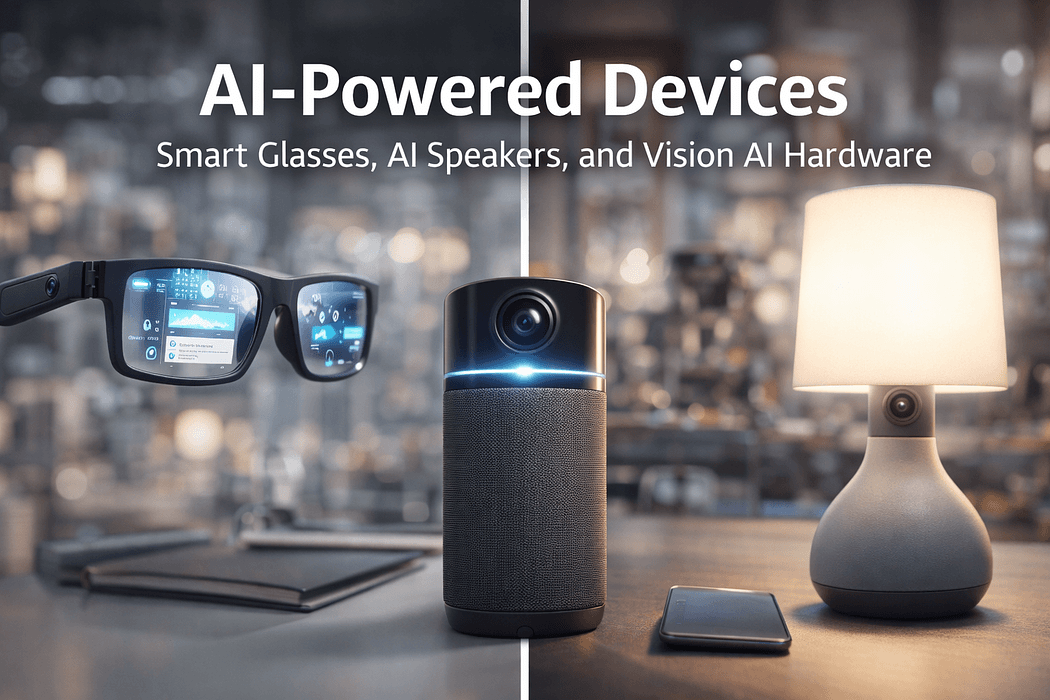
The next frontier of artificial intelligence is not a software update. It is the physical object on your face, on your kitchen counter, or mounted above your front door. AI-powered devices are rapidly moving from novelty to necessity, embedding intelligence directly into the hardware consumers use every day. From AI smart glasses that narrate the world in real time to vision AI cameras that understand what they see rather than merely recording it, the consumer hardware landscape is undergoing a transformation that will define the next decade of personal technology.
The first generation of smart devices was connected, not intelligent. A smart thermostat that learned your schedule was impressive in 2014. By today's standards, it is table stakes. The defining characteristic of current AI consumer devices is not connectivity. It is contextual awareness: the ability to understand what is happening, anticipate what is needed, and respond in ways that feel genuinely useful rather than merely automated.
This shift is being driven by three converging developments. On-device AI chips, such as Apple's Neural Engine, Qualcomm's AI-focused Snapdragon processors, and Google's Tensor chips, have made it possible to run sophisticated AI models locally without a round trip to the cloud. Multimodal AI models can now process voice, vision, and text simultaneously. And miniaturization has made it practical to embed these capabilities into form factors that people will actually wear or place in their homes.
The result is a new category of AI hardware technology that sits at the intersection of personal computing, ambient intelligence, and physical sensing. Understanding the distinct capabilities and use cases of each device type is essential for both consumers evaluating purchases and professionals assessing where AI hardware will intersect with their industry.
AI smart glasses represent perhaps the most significant hardware category to emerge from the current wave of consumer AI hardware. The Meta Ray-Ban glasses, now in their second generation, demonstrated that AI glasses technology does not require a bulky headset or a visible screen. A forward-facing camera, open-ear speakers, and a microphone array, combined with on-device and cloud AI processing, create a wearable that can answer questions about what you are looking at, identify objects, read text aloud, translate signs, and maintain a conversational context throughout your day.
The practical applications extend well beyond general consumer use. Field service technicians can receive real-time guidance overlaid on the equipment they are repairing. Medical professionals can review patient data hands-free during procedures. Architects and engineers can reference plans and specifications without stopping to consult a device. For any professional whose work involves both physical tasks and information access, AI wearable devices in the glasses form factor represent a meaningful productivity tool.
The competitive landscape is accelerating. Google has re-entered the smart glasses market following the lessons learned from Google Glass. Samsung and Qualcomm have announced collaborative development on AI-powered glasses hardware. Apple's Vision Pro, while a separate device category, has validated consumer willingness to invest in premium wearable AI experiences. The next two years will likely see AI glasses technology reach a level of capability and price accessibility that makes widespread professional adoption realistic.
The AI smart speaker market has existed long enough that it is easy to underestimate how dramatically the underlying capability is changing. First-generation smart speakers responded to explicit commands. The current generation, anchored by devices like Amazon Echo with Alexa Plus, Google Nest with Gemini integration, and Apple HomePod with advanced Siri capabilities, are shifting toward proactive, contextually aware AI assistant devices that understand ongoing situations rather than isolated requests.
The key technical development enabling this shift is the integration of large language models with the ambient listening capability of always-on speakers. Instead of pattern-matching a command against a fixed library of skills, these devices can now engage in multi-turn reasoning, remember context across a conversation, and access real-time information to respond with genuine relevance. The gap between asking a smart speaker a question and asking a knowledgeable colleague the same question is narrowing considerably.
For AI smart home devices more broadly, the speaker is increasingly the hub. Integrations with smart lighting, climate control, security systems, and appliances allow the AI layer to coordinate across the home environment rather than controlling individual devices in isolation. A morning routine that adjusts lighting, starts the coffee maker, reads your calendar, and briefs you on relevant news is no longer a demonstration scenario. It is a standard configuration available on current hardware.
The AI camera devices category is where voice and vision AI devices converge most powerfully. Security cameras have been a commodity product for years. What distinguishes the current generation is semantic understanding: the ability to distinguish a person from a shadow, recognize a specific individual, identify an unusual behavior pattern, or alert you not just to motion but to meaningful events.
Google Nest cameras use on-device AI to distinguish package deliveries from general pedestrian traffic, recognize familiar faces, and generate natural language descriptions of activity. Arlo's AI-powered cameras can identify animals, vehicles, and people separately, dramatically reducing the noise of irrelevant notifications that made earlier smart cameras more frustrating than useful. These capabilities run on dedicated AI hardware acceleration chips embedded directly in the camera units.
Beyond home security, AI camera devices are being deployed in retail for loss prevention and customer behavior analysis, in healthcare for patient monitoring and fall detection, and in manufacturing for quality control inspection. The AI powered hardware in these devices enables consistent, tireless visual analysis at a cost and scale that human monitoring cannot match. This is AI hardware technology operating at the boundary of consumer and industrial application.
Beyond the established categories, several newer AI powered gadgets are signaling where consumer AI hardware is heading. The Rabbit R1 and Humane AI Pin generated significant attention as attempts to build AI-first devices that bypass the smartphone entirely. While both products received mixed reviews for their initial execution, they represented important experiments in defining what a dedicated AI hardware device should feel like from a user experience perspective.
AI-powered earbuds are a rapidly maturing category. Devices like the Sony LinkBuds and Samsung Galaxy Buds now incorporate AI for real-time translation, adaptive noise cancellation that responds to your environment, and health monitoring including heart rate and posture detection. The earbud form factor is particularly compelling for AI assistant devices because it combines audio input and output with proximity to both the user's voice and ambient sound in a device people already wear for hours daily.
AI-integrated laptops and tablets are also undergoing a fundamental redesign around AI hardware acceleration. Microsoft's Copilot Plus PCs and Apple's M-series chips with dedicated Neural Engines are bringing on-device AI processing powerful enough to run capable language models locally, without an internet connection, directly on personal computers. This has significant implications for privacy, latency, and offline capability in professional AI workflows.
The benefits of AI-powered devices converge around three core themes. First, reduced cognitive load: devices that understand context handle more of the information management and decision-making overhead that currently consumes significant mental bandwidth throughout a workday. Second, accessibility: AI hardware that processes voice and vision natively makes powerful computing accessible to users who are limited by traditional keyboard and screen interfaces. Third, ambient intelligence: AI that operates in the background without requiring explicit interaction creates genuine convenience rather than additional things to manage.
For enterprises evaluating future AI hardware investments, the strongest case is productivity augmentation in roles that involve both physical presence and information access. Field operations, healthcare delivery, logistics management, and retail environments are all contexts where AI consumer devices deployed at scale could measurably reduce errors and response times.
Privacy is the most significant concern across all categories of AI-powered devices, and it deserves direct engagement rather than dismissal. Devices with always-on microphones, forward-facing cameras, and persistent cloud connectivity create data collection surfaces that are substantially larger than those of previous consumer technology. Understanding what data is processed on-device versus transmitted to cloud infrastructure, how long it is retained, and who has access to it should be a baseline evaluation criterion before deploying any AI hardware in professional or home environments.
Battery life and heat management remain practical constraints on what AI hardware can do in mobile and wearable form factors. Running sophisticated AI models on-device is computationally intensive, and current battery technology creates real trade-offs between AI capability and device endurance. This is improving with each chip generation, but it remains a genuine limitation for categories like AI smart glasses where users expect all-day wearability.
Platform fragmentation also presents a challenge for enterprise buyers. AI smart home devices from different manufacturers often operate within closed ecosystems that limit interoperability. The Matter smart home standard is improving this situation, but the AI intelligence layers of these devices, as opposed to the basic device control protocols, remain largely proprietary. Organizations deploying AI hardware at scale need to assess long-term ecosystem lock-in alongside the immediate capability benefits.
AI-powered devices are transitioning from early-adopter territory to mainstream consumer and enterprise infrastructure. The categories covered here, smart glasses, intelligent speakers, vision AI cameras, and emerging AI wearables, each represent a distinct approach to embedding intelligence into the physical environment. Together, they describe a future in which AI is not something you open on a screen but something that is simply present in the tools and environment around you.
For consumers, the practical guidance is to evaluate AI hardware not on the basis of feature lists but on the quality of the intelligence layer. A device that genuinely understands context and reduces friction in your specific workflow is worth meaningful investment. A device that adds complexity in exchange for occasional novelty is not.
For businesses, the strategic question is which physical touchpoints in your operations could be meaningfully augmented by AI hardware over the next three years. The technology is ready. The hardware is shipping. The organizations that build familiarity and deployment experience now will have a significant advantage over those who wait for the category to fully mature before engaging with it.