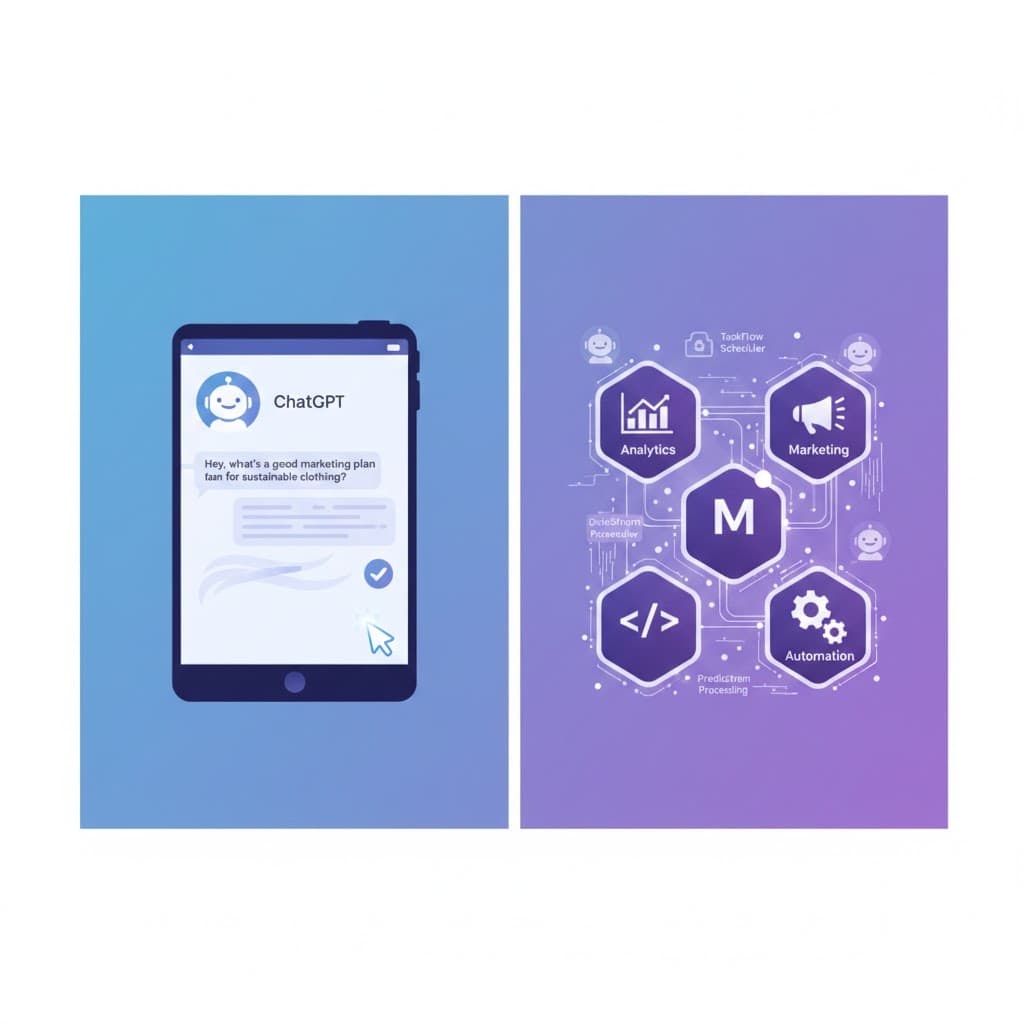
If you've been following the news on artificial intelligence, you've likely heard about ChatGPT. You may also be hearing a new term popping up: AI agents. They both sound similar, and both are powered by AI, but they are fundamentally different tools. Understanding this difference is key to knowing how AI can help you in your work and daily life. Let's break down what each one is, how they work, and why the rise of AI agents represents a significant shift in what computers can do for us.
What is ChatGPT?
Think of ChatGPT as an incredibly knowledgeable and responsive conversational partner. You give it a prompt—a question, a request for a poem, or a task like summarizing an article—and it generates a text response based on the patterns it learned from its vast training data. It's designed for a single, back-and-forth interaction. Its core function is understanding and generating human-like language. You are in the driver's seat for the entire process, providing each new instruction. ChatGPT excels at creative tasks, explanations, drafting content, and answering questions based on its knowledge. It's a powerful tool for brainstorming, writing assistance, and learning. For example, you can ask ChatGPT to "write a job description for a social media manager," and it will produce a well-structured draft. You can then ask it to "make that more formal" or "shorten it to 200 words." Each request requires your direct input.
What Are AI Agents?
Now, imagine giving that knowledgeable partner a list of tasks, some tools (like internet access, a calculator, or software), and the ability to make decisions on its own to complete them. That is an AI agent. An AI agent is an AI system that can perceive its environment, make decisions, and take actions to achieve a specific goal autonomously. Instead of just talking, an AI agent can do things. It can break down a complex goal into steps, use different tools, and navigate the digital world with minimal human intervention. If ChatGPT is a brilliant conversationalist, an AI agent is like an autonomous project manager that can execute plans. A real-world example would be an AI travel agent. You could tell it: "Plan a 5-day trip to Tokyo for next month for two people, with a budget of $3000, focusing on food and modern art." The agent could then search the web for flights, check hotel availability, book reservations at highly-rated restaurants, and compile an itinerary into a document—all by itself after the initial command.
ChatGPT vs AI Agents: A Side-by-Side Comparison
To make the distinction crystal clear, let's compare their core characteristics. Primary Function: ChatGPT is a conversational language model. Its main job is to communicate. AI agents are autonomous executors. Their main job is to accomplish tasks.
How They Work: ChatGPT reacts to your immediate prompt. You ask, it answers. The interaction is a cycle of prompt and response. AI agents pursue a set goal. You give an objective, and they plan and act independently until it's done or they need clarification.
Level of Autonomy: ChatGPT has zero autonomy. It requires constant human direction. AI agents have high autonomy. They make decisions about the steps needed to reach a goal.
Tools and Actions: ChatGPT is generally self-contained. It uses its training data to generate text. AI agents can use tools. They can connect to web browsers, databases, email systems, booking APIs, and other software to perform real-world actions.
Use Cases and Applications
Both tools are useful, but for different purposes. ChatGPT is ideal for: Content creation like blog posts, emails, and social media captions. Brainstorming ideas for projects or names. Tutoring and explaining complex topics simply. Editing and refining existing text. Simple Q&A based on its knowledge. AI agents are ideal for: Business automation: Automating complex workflows like lead qualification or customer support ticketing. Personal assistance: Managing your calendar, researching and booking travel, or monitoring prices online. Data analysis: Gathering data from multiple sources, analyzing it, and creating a report. Software development: Writing, testing, and debugging code across multiple files to build a small application.
Understanding the Limitations
Knowing the limits of each technology is just as important as knowing their strengths. ChatGPT limitations are significant when it comes to action. It cannot verify real-time information on its own, perform actions in other software, or execute multi-step projects without you guiding each step. It can sometimes produce confident but incorrect information.
AI agents, while powerful, come with their own considerations. They can be complex to set up, requiring clear instructions and access to the right tools. There is a higher potential for errors in a chain of actions—if one step goes wrong, the whole task can derail. Letting an AI act autonomously also requires careful oversight, especially with sensitive tasks.
The Future of AI Tools
ChatGPT revolutionized how we interact with machines through natural language. AI agents are now revolutionizing what we can delegate to machines. The future likely involves a blend: using conversational AI like ChatGPT to brainstorm and plan, and then deploying AI agents to handle the execution of those plans. For beginners, starting with ChatGPT is a fantastic way to learn the basics of AI prompting. As you get comfortable, exploring AI agents—often available through platforms that offer automation—can unlock new levels of productivity by handling tedious, multi-step tasks.
Key Takeaways and Next Steps
In summary, ChatGPT is a reactive tool for conversation and content creation, while AI agents are proactive systems for task automation and execution. One is for talking and thinking, the other is for planning and doing. Your next step is to experiment. Try using ChatGPT for a week for writing and research tasks. Then, explore an AI agent platform (many are emerging online) and try a simple automated task, like having it summarize the top news articles for you each morning. By understanding the distinct role of each, you can harness the right type of AI for the right job.