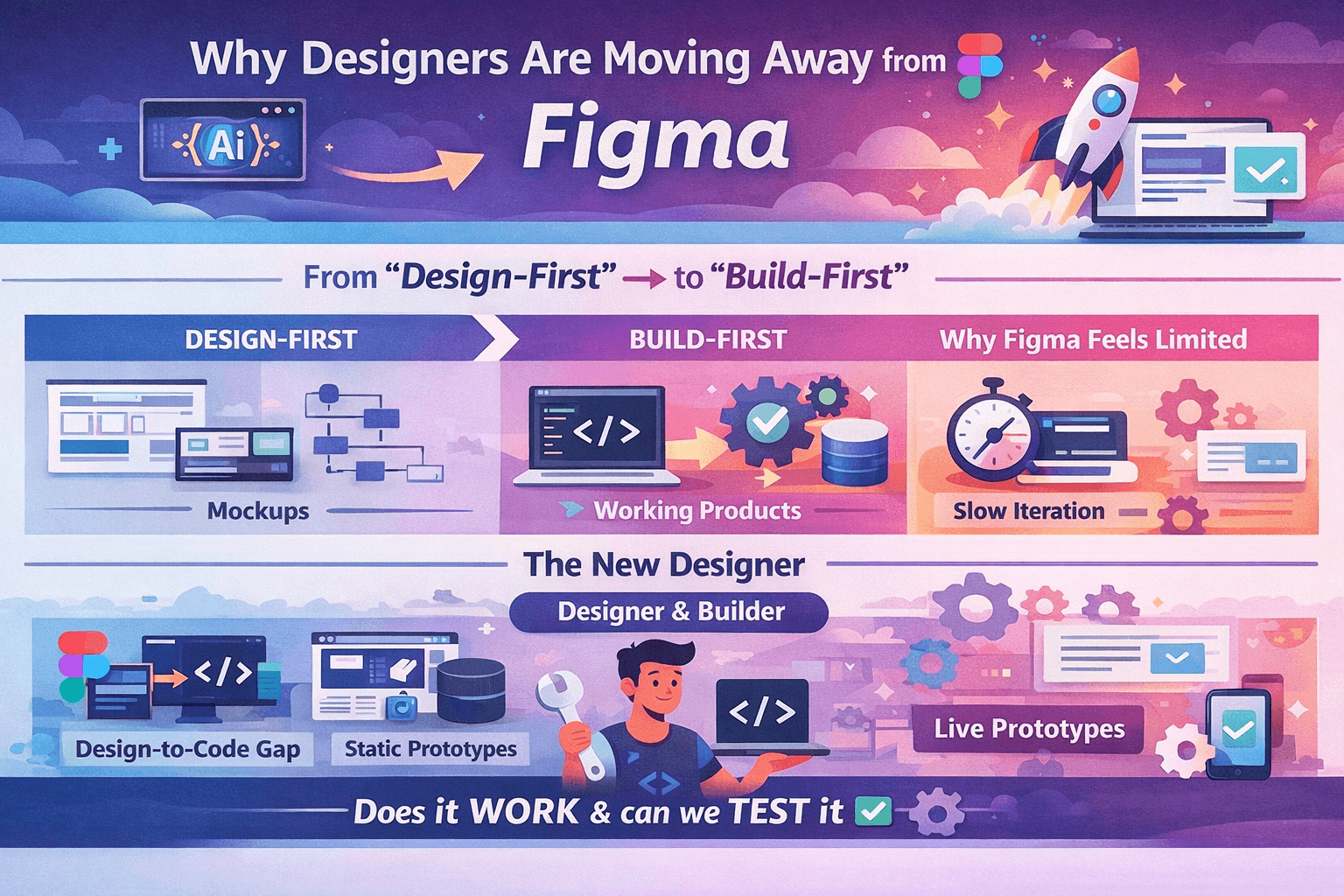
Today, Figma is still widely used—but many designers are starting to depend on it less. This is not because Figma is bad. It’s because the way products are built has changed.
Design Has a New Goal: Working Software
Earlier, the main job of a designer was to create screens, user flows, and clickable prototypes. Once the design was approved, developers would build the real product. Now, teams want working software as early as possible. Instead of just showing designs, designers are expected to show functional screens, real interactions, live data, and testable flows. A beautiful mockup is no longer enough.
AI Tools Changed the Workflow
AI-powered development tools allow designers to generate frontend code, build real UI components, connect APIs or dummy data, and deploy prototypes quickly. This has reduced the gap between idea → design → code. Designers don’t want to stop at “handoff”. They want to build and test directly. This mindset shift is often called a move from “design-first” to “build-first”.
Where Figma Starts Feeling Limited
Figma is excellent for visual design, but it struggles in a build-first workflow. Here are the main reasons:
1. Design-to-Code Gap Still Exists Even today, a Figma design must be converted into real code. This takes time and engineering effort. AI-based tools aim to remove this step completely.
2. Prototypes Are Not Real Figma prototypes don’t handle real data, don’t manage application state, and don’t include business logic. They look interactive, but they don’t behave like real applications.
3. Slower Iteration Compared to AI Tools With AI coding tools, you can describe a change in text and instantly see it working in real code. In Figma, you redesign the UI and then developers re-code it. This doubles the work.
What Companies Want Now
Companies are focusing on faster validation, fewer handoffs, and real user feedback early. They prefer a simple working product over a perfect design that doesn’t run. That’s why more designers are exploring tools outside pure design platforms.
Does This Mean Figma Is Dying?
No. Figma is not going away. It will still be used for visual design, design systems, UI consistency, and team collaboration. But it may no longer be the center of product creation. Instead, Figma is becoming one tool among many, not the starting and ending point.
The New Designer Skillset
Modern designers are expected to understand basic frontend logic, think about states and flows, use AI tools to build real UIs, and collaborate closely with developers—or act as one. The future designer is not just a designer. They are a builder-designer.
Final Thought
The industry is not rejecting Figma. It is rejecting slow, disconnected workflows. The main question has changed from "How does it look?" to "Does it work, and can we test it today?" Design is no longer just about screens. It’s about shipping real products faster. And that’s why many designers are slowly moving beyond Figma.