
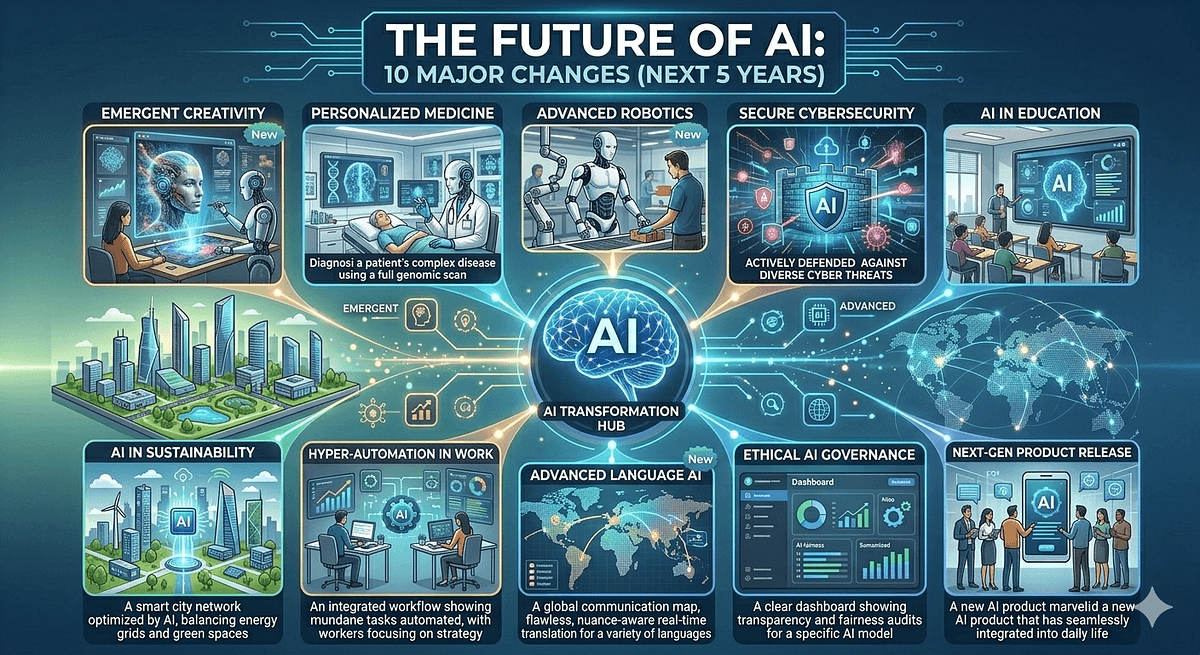
Predicting the future of AI is harder than it looks, not because the trends are unclear but because they are moving faster than most forecasting frameworks can track. The AI market is projected to reach 826 billion dollars by 2030, growing at an annual rate of 27.67 percent, compared to an average market growth rate of roughly 4 percent. Companies that have integrated AI are already reporting 22 percent reductions in process costs and 80 percent productivity improvements. What is coming in the next five years, however, is substantially larger in scope than anything deployed so far. These are the ten most significant changes in AI technology that researchers, industry analysts, and the leading AI labs themselves are projecting between now and 2030.
The shift from AI that answers questions to AI that executes multi-step tasks autonomously is already underway and will define the next phase of AI technology future. Forty-one percent of businesses predict that up to half of their core business processes will run on AI agents by the end of 2025, and over half of all companies are expected to have deployed AI agents into their workflows by 2027. AI agents operate as digital coworkers: a three-person team using AI agents to handle data analysis, content generation, and campaign personalization can launch a global marketing campaign in days rather than weeks.
What makes this shift structurally significant rather than incremental is that agentic AI does not just compress the time required to complete existing work. It enables small teams to take on tasks previously requiring larger organizations, eroding structural advantages that have historically protected incumbents. For businesses and individuals, the practical implication is that AI fluency is becoming a multiplier on organizational capacity rather than simply a productivity tool.
The length of coding tasks that AI can handle autonomously has doubled every seven months from 2019 to 2024 and every four months since. On current trends, AI coding systems will be able to complete software tasks that would take a skilled human engineer years, with 80 percent reliability, by early 2027. By 2028, Gartner projects that 75 percent of enterprise software engineers will use AI coding assistants as a standard part of their workflow. By 2030, fully autonomous software development pipelines, where AI plans, codes, tests, and deploys features with minimal human oversight on routine work, are a high-probability outcome.
The implication for the software industry is not the elimination of developers but a dramatic restructuring of the role. System design, requirements specification, security review, and the judgment calls that determine what software should do will become the primary human contribution. The execution layer of software development, which has historically consumed the majority of engineering time, will be increasingly automated.
The World Health Organization projects a shortage of 11 million health workers by 2030, leaving 4.5 billion people without access to essential health services. AI is emerging as the most credible mechanism for bridging that gap. Microsoft's AI Diagnostic Orchestrator solved complex medical cases with 85.5 percent accuracy in 2025, compared to a 20 percent average for experienced physicians on the same cases. AI and Bing are already answering more than 50 million health questions daily, functioning as a first-line health resource for a significant fraction of the global population.
AI drug discovery is moving from research to clinical validation. Multiple AI-designed drug candidates are in mid-to-late-stage clinical trials as of 2026, with oncology and rare diseases as the leading domains. If current trial success rates hold, AI-discovered drugs reaching market approval by 2028 to 2029 would represent one of the most consequential AI advancements coming for human welfare.
Humanoid robots with AI are transitioning from research demonstrations to commercial production. Tesla's Optimus, Figure AI's robot, and Agility Robotics' Digit are already operating in real factory and warehouse environments. Goldman Sachs projects the humanoid robot market will reach 38 billion dollars by 2035, with significant commercial deployments in manufacturing, logistics, and retail beginning in the 2026 to 2028 window. The key technical driver is AI-powered simulation training: robots that learn by failing billions of times in virtual environments before touching the physical world have crossed a capability threshold that makes commercial deployment viable.
Autonomous vehicles are on a parallel track. Fully autonomous vehicles are expected to be operational across major cities by 2030, with Waymo and Zoox projected to capture double-digit market share in cities like Los Angeles and Miami according to Forbes. The convergence of AI decision-making, sensor hardware, and high-definition mapping has moved autonomous vehicles from technology demonstrations to expanding commercial fleets.
By 2030, Epoch AI's research projects that AI will be able to implement complex scientific software from natural language descriptions, assist mathematicians in formalizing proof sketches, and answer complex protocol questions in molecular biology. The framing from Microsoft Research is that in 2026, AI will stop summarizing papers and start actively participating in the discovery process in physics, chemistry, and biology. Climate modeling, materials design, and molecular dynamics are already benefiting from AI acceleration.
The compounding effect matters here. If AI can help scientists work faster, it accelerates the pace at which AI research itself advances, creating a feedback loop that is difficult to model linearly. This is why the AI future predictions from leading researchers consistently caution that the 2027 to 2030 window involves significant uncertainty: the trajectory of AI improvements to AI development is inherently less predictable than straight-line extrapolation from current trends.
Today's multimodal AI models that handle text, images, audio, and video simultaneously are early versions of what will become the default interface by 2030. By then, AI systems will integrate real-time data from wearables, IoT devices, and continuous digital interactions to create highly personalized, context-aware experiences across health, retail, education, and communication. The unimodal AI that processes a single data type will be a legacy architecture by the end of the decade.
In education, AI tutors that adapt in real time to individual learning styles, attention patterns, and knowledge gaps will begin displacing standardized instruction formats. In retail, AI will predict and respond to individual customer needs before the customer explicitly expresses them. AI-driven customer interactions are projected to be a competitive necessity rather than a differentiator for consumer businesses by 2027.
One of the more structurally unusual AI trends 2030 forecasters are tracking is the rise of machine customers: AI agents that make purchasing decisions on behalf of humans without human initiation of each transaction. Your printer ordering its own ink when levels are low, your smart refrigerator restocking groceries based on your consumption patterns, and your calendar automatically booking a service when a scheduling window opens are early examples of this pattern.
Gartner projects that by 2030, 20 percent of revenue across many consumer categories will come from machine customers rather than human-initiated purchases. This has significant implications for marketing, user experience design, and commerce infrastructure: optimizing for an AI agent making a decision is a fundamentally different design problem than optimizing for a human browsing a product page.
The regulatory landscape for AI is moving from voluntary guidelines to enforceable law in most major jurisdictions. The EU AI Act 2025 is already in force, requiring risk-based compliance for AI systems deployed in the European market. Gartner predicts that by 2027, 70 percent of new employment contracts will include clauses governing the licensing and fair use of employee AI personas, creating a new category of intellectual property and labor law.
The transatlantic regulatory divergence between the US and EU approaches is creating genuine operational complexity for globally operating organizations. Managing AI compliance across jurisdictions with different transparency, explainability, and liability requirements will become a material operational cost and a strategic variable in decisions about where to build and deploy AI systems.
Public human-generated text on the internet, the primary training resource for large language models, is projected to be largely exhausted as a source of new training signal by 2026 to 2027. The response from the AI industry is a major shift toward synthetic data: AI-generated training data that can be produced at effectively unlimited scale and curated for specific capability development. By 2030, the majority of AI models are expected to be trained primarily on synthetic rather than organic human-generated data.
This transition has significant implications for AI capabilities and alignment. Models trained on synthetic data can be steered toward specific competencies more precisely than models trained on the open web, but they may also be more susceptible to systematic biases in the synthetic generation process. Gartner projects that 75 percent of businesses will use AI to generate synthetic customer data for model training by 2030.
The WEF projects 85 million job displacements alongside 97 million new job creations by 2030. The net positive number matters less than the distribution: the new roles are concentrated in AI development, oversight, green energy, and care sectors, while the displaced roles are concentrated in administrative processing, entry-level analysis, and routine customer interaction. These populations do not overlap geographically or in skills, making the transition a policy and education challenge as much as an economic one.
The most consistent finding from current labor market research on AI exposure is that higher-skill occupations are seeing productivity augmentation and rising wages, while routine-task occupations are experiencing wage compression and reduced employment in affected sectors. The structural advice for individuals is consistent across forecasters: build fluency in AI tools, focus development on the judgment, creativity, and accountability dimensions of your role, and treat AI literacy as a baseline professional requirement rather than a specialist skill.
The future of artificial intelligence over the next five years is not a single story but ten parallel transformations happening simultaneously across autonomous agents, coding, healthcare, physical robotics, science, multimodal interfaces, commerce, regulation, data infrastructure, and the labor market. Each is individually significant. Together, they constitute a restructuring of the economic and technological environment that is happening faster than any previous technology transition in modern history.
The most actionable insight from the AI innovations future research is straightforward: the organizations and individuals who build direct experience with current AI tools now will be substantially better positioned to navigate these transitions than those who wait for the technology to stabilize before engaging. The technology is not going to stabilize. Familiarity with the current generation of AI is the foundation from which every subsequent adaptation becomes easier to make.