
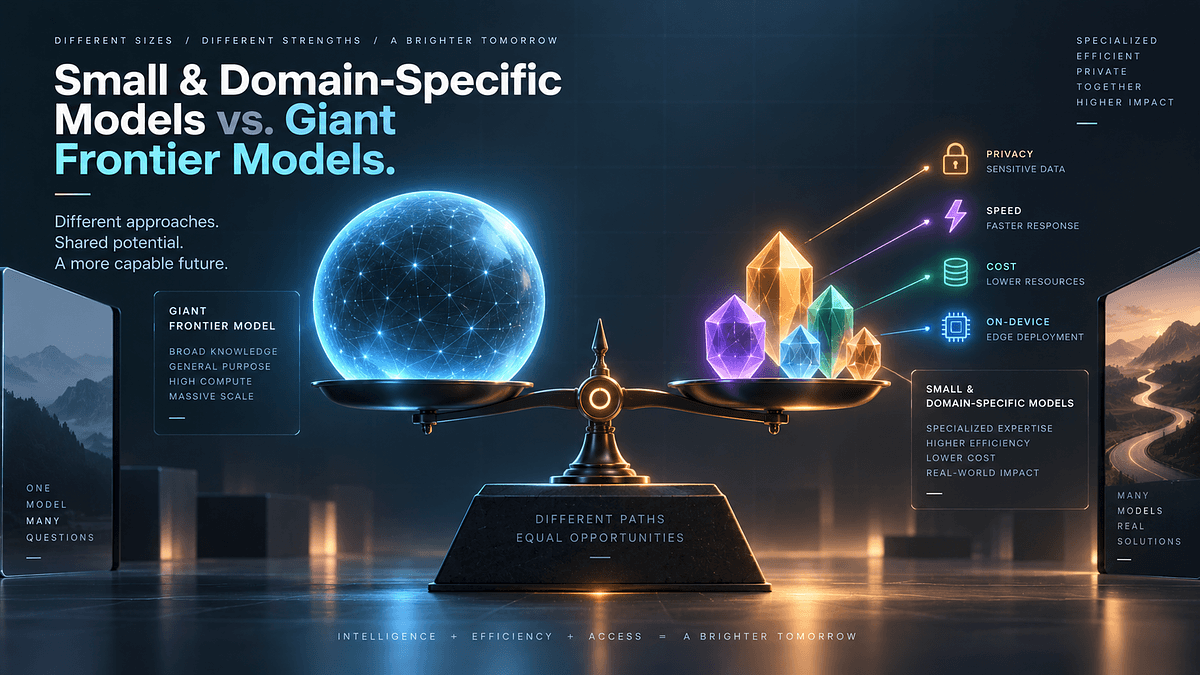
Remember when bigger was just automatically better in AI? Yeah, that era's fading fast. The small language models vs frontier models debate has flipped in a way that would've sounded ridiculous even eighteen months ago, and now IBM Granite, Liquid AI's LFM line, and Nvidia's Nemotron family are quietly running circles around trillion-parameter giants on the exact tasks most businesses actually care about. So what's going on here? Let's dig into why smaller, sharper models are having such a moment, and why that matters whether you're an enterprise architect or just someone trying to understand where this industry is headed.
Here's the thing everyone eventually figures out: a frontier model that can write poetry, debug code, and explain quantum mechanics is massively overqualified for a task like extracting a shipping address from an email. You wouldn't hire a surgeon to put on a Band-Aid, right? That's basically what's happening every time a company routes a simple tool call or classification task through a giant, expensive, general-purpose model.
Domain-specific AI models 2026 are built around a much simpler premise: train a smaller network on exactly the kind of task it'll actually see in production, and it'll often beat a much larger generalist on that narrow task. Liquid AI proved this in a pretty striking way with its tiny LFM2.5-230M model, which scored 43.26 on the BFCLv3 tool-use benchmark and comfortably beat IBM's own Granite 4.0-350M and models several times its size on structured data extraction. A 230-million-parameter model beating a 1-billion-parameter competitor isn't a fluke, it's the whole point.
Once you see that pattern, the rest of this shift starts making a lot more sense, so let's look at the three companies actually leading it.
IBM Granite vs frontier models isn't really a fair fight in the way people usually frame comparisons, because Granite was never trying to be the smartest model in the room. It was built to be the reliable one. Granite 4.1 shipped as a family of ten models, spanning 3B, 8B, and 30B parameter LLMs alongside a dedicated safety model, a vision-language model for document extraction, and a multilingual speech recognition model, all clearly aimed at the unglamorous but essential work enterprises actually need done.
That breadth matters more than it might sound. A company doing document processing doesn't need one model that does everything adequately, it needs a small model that nails OCR extraction, another that flags safety issues, and another that handles multilingual transcription reliably. Granite's function-calling focus and enterprise benchmark performance have made it a go-to building block for exactly this kind of modular, task-specific pipeline rather than a single monolithic assistant.
That modularity is a nice segue into Liquid AI, a company that's taken the small-model philosophy even further toward the edge of what's physically possible to run.
Liquid AI LFM efficient models exist because someone finally asked the obvious question: what if the model didn't need a data center at all? Liquid AI has pushed aggressively toward on-device AI privacy models, and its LFM2.5-230M is small enough to run essentially anywhere, including directly on a robot's onboard compute rather than phoning home to a cloud API for every decision.
That's not a hypothetical either. Liquid AI demonstrated LFM2.5-230M running entirely on a Unitree G1 humanoid robot's onboard Jetson Orin module, processing complex environmental commands locally in real time. Think about what that actually means for edge AI deployment 2026: no network latency, no data leaving the device, no recurring per-call costs, and no dependency on an internet connection that might not exist in a warehouse, a factory floor, or the middle of a field.
This privacy-and-latency angle is a big part of why smaller models keep winning arguments that have nothing to do with raw intelligence, which brings us to Nvidia's approach of building efficiency directly into the model architecture itself.
Nvidia Nemotron small model releases have leaned hard into a hybrid architecture strategy that squeezes way more capability out of a given parameter budget than a traditional transformer would. Take Nemotron-3-Nano-Omni-30B-A3B-Reasoning, which is genuinely fascinating once you look under the hood. It's a 31-billion-parameter Mamba2-Transformer hybrid mixture-of-experts model, but it only activates about 3 billion parameters per forward pass, and it still handles video, audio, images, and text from a single efficient endpoint.
The benchmark numbers back up the efficiency story pretty convincingly too. That model scores 82.8 on visual math reasoning, over 89 on speech instruction following, and holds its own on GUI agent and video understanding tasks, all while running at a fraction of the compute cost of a dense model with a comparable parameter count. Nvidia's larger Nemotron-3-Super variant takes a similar hybrid approach and still handles a full million tokens of context at over 91 percent accuracy on long-context retrieval, which is a genuinely hard problem to solve efficiently at any size.
So we've got three different philosophies, enterprise modularity, edge-first minimalism, and architectural efficiency, all converging on the same conclusion. Let's talk about why that conclusion is such good news for anyone paying the bills.
Small language models cost savings aren't a minor side benefit, they're often the entire business case. Running a lightweight, specialized model for a narrow, high-volume task can cost a tiny fraction of routing every single call through a frontier-tier model, and that difference compounds fast once you're processing millions of requests a day. A classification task that a 3B model nails just as well as a 300B model shouldn't be paying 300B-model prices, full stop.
There's also a speed dimension that's easy to overlook. Smaller models generally respond faster, which matters enormously for real-time applications like voice assistants, robotics, or interactive agents where a two-second delay ruins the experience. Combine lower cost with lower latency and you get a pretty compelling argument for rethinking the default assumption that bigger is always the safer choice.
Specialized AI models enterprise deployments are popping up everywhere once you start looking. A few patterns keep showing up across industries:
- Document-heavy operations using Granite-style vision-language models for OCR and structured data extraction instead of routing scanned PDFs through an expensive general model
- Robotics and industrial automation using models like LFM2.5-230M as an on-device skill-selection layer that decides what action to take without any cloud round trip
- Customer service pipelines using small models for intent classification and routing, reserving frontier models only for the genuinely complex conversations that need them
- Multimodal edge devices running Nemotron-style hybrid models to process audio and video locally for privacy-sensitive applications
Agentic AI small models fit into this picture in a particularly interesting way, because a lot of what an AI agent does isn't deep reasoning, it's calling the right tool with the right parameters over and over again. That's precisely the kind of narrow, repetitive task where a small, fast, cheap model shines, while the heavier reasoning gets escalated to a bigger model only when it's actually needed.
None of this means frontier models are becoming irrelevant, so let's not get carried away. SLM vs LLM comparison shouldn't be an either-or decision, it should be a routing decision. Small models excel at narrow, well-defined tasks with clear success criteria, but they still struggle with genuinely novel reasoning, ambiguous multi-step problems, and tasks that require broad world knowledge outside their training focus.
There's also real engineering overhead in managing a fleet of specialized models instead of one general-purpose API, since you now need routing logic, monitoring across multiple model types, and a clear sense of which task goes where. Getting that routing wrong, sending a complex reasoning task to a tiny extraction model, can produce worse results than just using the big model in the first place.
The small language models vs frontier models story in 2026 isn't really about small beating big, it's about the industry finally admitting that one-size-fits-all was always a compromise. IBM Granite, Liquid AI, and Nvidia Nemotron each attack the same underlying problem from a different angle, whether that's enterprise reliability, on-device privacy, or architectural efficiency, and together they're proving that matching model size to task complexity beats defaulting to the biggest model available. If you're building AI systems in 2026, the smartest move isn't picking a side, it's building a routing strategy that sends each task to the smallest model that can actually handle it well.