
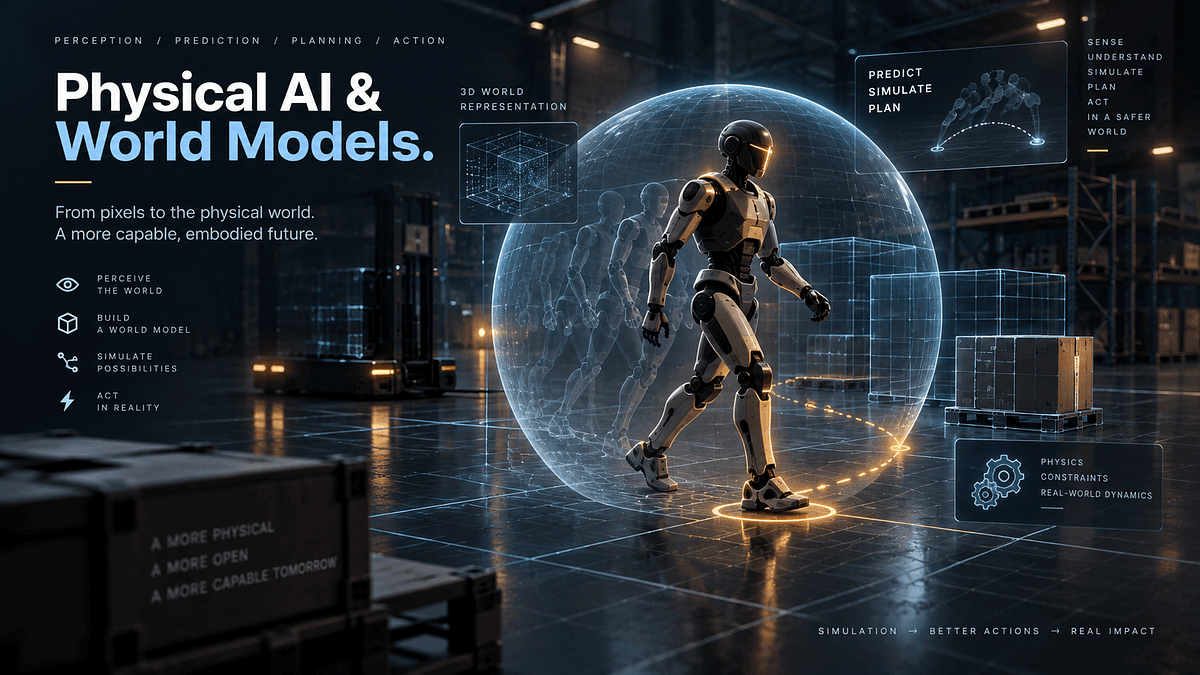
Every conversation about artificial intelligence over the past three years has centered on language, but the frontier quietly shifting the industry's attention in 2026 is physical AI world models, systems built not to answer questions but to understand and predict how the physical world behaves. Nvidia has positioned itself at the center of this shift with its Cosmos world foundation models and the Isaac GR00T robotics platform, giving humanoid and industrial robots a way to reason about space, physics, and consequence before they ever move a limb. This matters far beyond robotics labs, because it represents the clearest evidence yet that AI beyond chatbots is becoming a serious engineering discipline with its own infrastructure, data pipelines, and hardware stack.
A large language model predicts the next token in a sequence of text, but a world foundation model predicts what happens next in a physical scene given an action or instruction. Embodied AI in 2026 depends on this distinction because a robot cannot simply generate plausible-sounding text about picking up a cup; it needs a model that understands gravity, friction, occlusion, and the consequences of a misjudged grip before that action ever executes in the real world.
Nvidia's Cosmos world model line was built specifically to close this gap, and by mid-2026 its models had already been downloaded over three million times by developers looking to generate diverse training data using text, image, and video prompts. Cosmos 3, released in May 2026, pushed the concept further as Nvidia's first fully open omnimodel, accepting text, images, video, ambient audio, and action sequences as input and producing the same range of modalities as output, effectively unifying world generation, vision reasoning, and action simulation in one system.
That leap from a narrow simulation tool to a genuinely omnimodal reasoning system is what sets up the next layer of the stack: giving a robot a body and a brain that can actually use what the world model understands.
Isaac GR00T began as an open foundation model for generalized humanoid reasoning, and it has evolved rapidly through successive versions into a full vision language action model capable of full-body control. GR00T 1.7, released under the permissive Apache 2.0 license, was pretrained on approximately 32,000 hours of real human demonstration data combined with 8,000 hours of simulation, and it incorporates a Cosmos-Reason backbone that acts as the robot's reasoning layer, turning ambiguous instructions into step-by-step plans grounded in physics and common sense.
By mid-2026, Nvidia extended this from a software platform into an actual reference robot with the Isaac GR00T Reference Humanoid, pairing a commercial humanoid chassis with tactile five-finger hands and a Jetson-based onboard compute module delivering over two thousand FP4 teraflops of inference performance. This gave academic and commercial teams a complete, purchasable robot brain AI stack rather than a research prototype requiring custom integration work.
The result is a platform where the model, the simulator, and the hardware are increasingly designed as one coherent product rather than separate components bolted together, which directly shapes how developers actually generate the data these systems need to learn from.
Humanoid robot training data has always been the fundamental bottleneck in this field, since collecting real-world demonstrations at scale is slow, expensive, and physically constrained by how many robots and human operators an organization can deploy. Cosmos world models address this directly by generating synthetic motion data from a small number of human demonstrations, and Nvidia has reported generating hundreds of thousands of synthetic trajectories, representing the equivalent of thousands of hours of human demonstration, in a matter of hours rather than months.
Combining this synthetic data with real demonstrations has produced measurable gains in downstream robot performance, with Nvidia reporting substantial accuracy improvements on manipulation tasks when synthetic and real data are blended rather than relying on real data alone. This approach effectively turns a data scarcity problem into a compute problem, which is a far more tractable challenge given the pace of GPU infrastructure improvements across the industry.
This synthetic data pipeline is also what makes cross-embodiment learning practical, since the same underlying world model can generate training scenarios for dramatically different robot bodies without needing a physical version of each one.
Warehouse robotics AI has become one of the clearest near-term beneficiaries of this stack, since manipulation and navigation tasks in structured environments are exactly the kind of repeatable, high-volume work that vision language action models handle well once trained on sufficiently diverse synthetic and real data. Industrial and logistics companies are already piloting GR00T-based systems for picking, sorting, and material handling tasks that previously required rigid, single-purpose robotic arms.
Beyond warehouses, the ecosystem building on Cosmos and GR00T spans a wide range of physical domains. Examples include the following:
- Humanoid manufacturers using Cosmos world models and Isaac Lab to validate robot designs in simulation before building physical prototypes
- Surgical robotics teams adapting specialized Cosmos variants for high-precision, low-tolerance manipulation tasks
- Construction and heavy equipment companies applying the same reasoning stack to autonomous machinery operating in unstructured outdoor environments
- Research institutions using the open GR00T foundation model to accelerate academic robotics work without building a foundation model from scratch
This breadth of adoption across dramatically different physical environments is a strong signal that the underlying world model approach generalizes well beyond any single robot form factor, which is precisely the promise embodied AI has been chasing for years.
The open licensing model behind much of this stack lowers the barrier to entry for organizations that previously could not justify building a robotics foundation model from scratch. Companies can now build on pretrained, commercially licensed models like GR00T 1.7 rather than starting from raw sensor data, dramatically shortening development timelines for task-specific robot skills. The synthetic data generation capability also reduces the capital cost of data collection, since a modest number of real demonstrations can be expanded into much larger training sets without deploying additional physical robots.
Physical AI still faces meaningful constraints that separate impressive demos from dependable deployment. The sim-to-real gap remains a persistent challenge, since a model trained heavily on synthetic data can behave unpredictably when it encounters real-world friction, lighting, or object properties that differ subtly from its training distribution. Hardware costs for humanoid platforms remain substantial even as software becomes more accessible, and safety validation for robots operating around people is a far higher bar than validating a chatbot's text output.
Organizations evaluating this technology should also recognize that benchmark performance in controlled research settings does not automatically translate to reliable performance across the long tail of unpredictable real-world scenarios that any deployed robot will eventually encounter.
Physical AI world models represent one of the clearest signs that artificial intelligence is expanding well beyond text generation into systems that can perceive, predict, and act within the physical world. Nvidia's Cosmos and Isaac GR00T stack illustrates how world foundation models, synthetic data generation, and purpose-built hardware are converging into a single coherent platform for humanoid and industrial robotics. Businesses evaluating this space should start by identifying narrow, repeatable physical tasks where synthetic data and existing foundation models can shortcut years of custom development, rather than waiting for a fully generalized robot brain to arrive.