
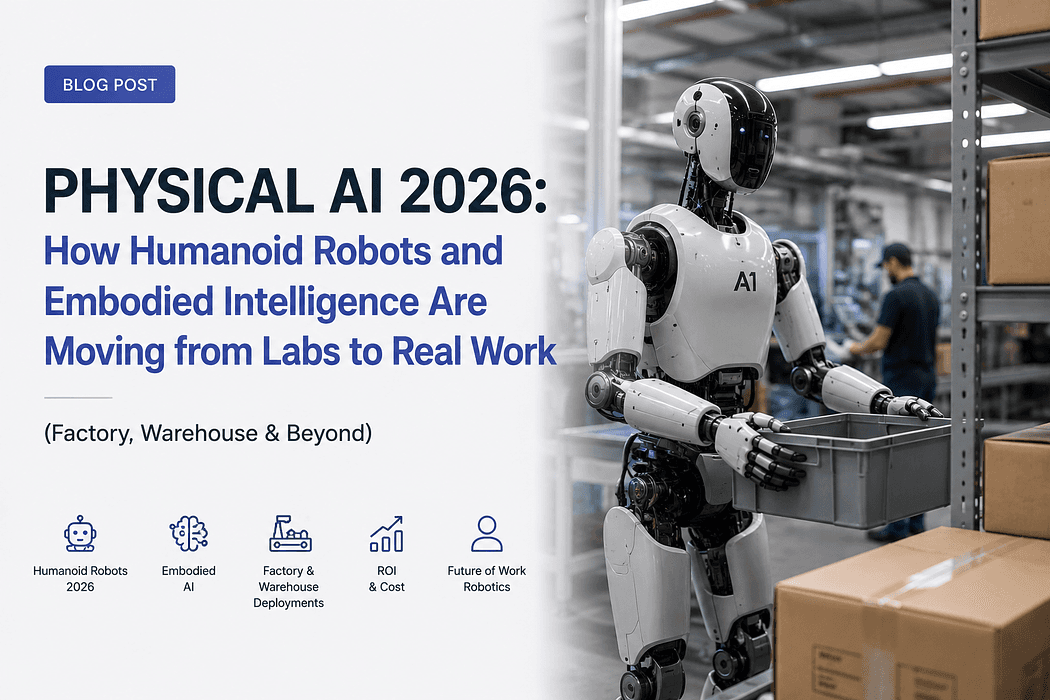
Hey, have you ever wondered when those sci-fi humanoid robots would stop being fancy lab demos and actually start pulling their weight on the factory floor? Well, 2026 looks like the year that shift is really happening. Physical AI 2026 is all about giving AI a body — embodied intelligence that can see, think, move, and act in the messy physical world. We're talking humanoid robots 2026 rolling into warehouses, factories, and beyond, teaming up with agentic AI robotics to handle the jobs that keep supply chains humming.
Physical AI combines advanced AI brains with robotic bodies that interact with the real world. Unlike digital AI stuck on screens, embodied AI lets machines perceive their environment through sensors, reason about tasks, and manipulate objects with human-like dexterity.
Think of it like this: your chatbot can write a perfect report, but it can't pick up a box that's fallen off a shelf or tighten a bolt on an assembly line. Humanoid robots 2026 bridge that gap. At CES 2026, this theme dominated — from Boston Dynamics' Atlas to LG's CLOiD and a bunch of others showing they are ready for real work, not just flashy videos.
The big leap comes from marrying large language models and agentic AI with better hardware — powerful edge chips from Nvidia, Qualcomm, and others, plus improved actuators and vision systems. Robots aren't just following scripts anymore; they're getting missions and figuring out how to complete them.
That brings us to the real excitement: deployments moving from pilots to production lines.
You might ask, are these things actually working in the wild yet? The answer in 2026 is a solid yes, especially in controlled industrial settings.
Hyundai Motor Group, through Boston Dynamics, showcased the latest Atlas at CES 2026 and plans gradual deployment across its operations, with full factory roles targeted soon after. BMW has run successful pilots with Figure AI's humanoid at its Spartanburg plant for material handling. Mercedes-Benz is testing Apptronik's Apollo for tote delivery. Agility Robotics' Digit is already in warehouse logistics with partners like GXO, handling tote movement and order fulfillment.
In manufacturing, humanoids tackle repetitive or ergonomically tough tasks — moving sheet metal, assembling components, or inspecting parts. Warehouses love them for picking, packing, and navigating dynamic spaces where traditional fixed robots struggle. Chinese players like Agibot and Unitree are shipping thousands of units, pushing costs down and accelerating adoption.
These aren't one-off experiments. Early fleets are running multi-shift operations, learning on the job through embodied AI that improves with real-world data.
So what's the draw? For starters, labor shortages in manufacturing and logistics aren't going away. Humanoid robots work 24/7 without fatigue, reducing injury rates dramatically on heavy or repetitive tasks.
Key wins include:
- Faster payback periods — many deployments target 18-24 months ROI in warehouses, with some high-utilization scenarios hitting payback in as little as 6-15 months.
- Productivity jumps of 30-50 percent or more in targeted workflows.
- Flexibility — one platform can switch between tasks without custom retooling, unlike traditional automation.
- Scalability as costs drop toward $15k-$250k per unit depending on capability.
**Humanoid robot cost ROI** looks compelling when you factor in continuous operation and lower error rates. Plus, they integrate with agentic AI robotics for higher autonomy — the robot doesn't just lift a box; it decides the best order, navigates obstacles, and hands off to the next station.
For factories, this means more resilient supply chains. For warehouses, it translates to handling peak seasons without scrambling for temporary workers. And beyond industry? Early moves into healthcare assistance, retail, and even home tasks are emerging.
Don't get me wrong — we're not at full general-purpose robot takeover yet. Many systems still need structured environments and human oversight for edge cases. Integration with existing systems can be tricky, and upfront costs plus maintenance add up if utilization isn't high.
Safety, regulatory approval, and public acceptance matter too, especially as robots work alongside people. Battery life, dexterity in highly variable tasks, and long-term reliability are improving fast but aren't perfect. Debugging embodied systems in the physical world is harder than fixing software bugs.
Then there's the future-of-work angle: these tools should augment humans, handling dangerous or mundane jobs so people focus on higher-value work. Smart companies are thinking about reskilling now rather than replacement.
If you're in manufacturing, logistics, or any physical operations, start small. Identify repetitive workflows where a humanoid could shine, run a pilot, and measure that all-important ROI. Look at platforms with strong agentic capabilities and ecosystem support.
Watch the tech stack — better perception, world models, and multi-robot coordination will accelerate progress. Companies that treat physical AI robots as team members rather than just machines will likely see the biggest gains.
Physical AI 2026 isn't science fiction anymore. With humanoid robot deployments gaining real traction in factories and warehouses, embodied intelligence is set to reshape how work gets done. The robots are here, learning on the job, and getting better every day. The question for your business is simple: will you be watching from the sidelines, or piloting the next wave?