
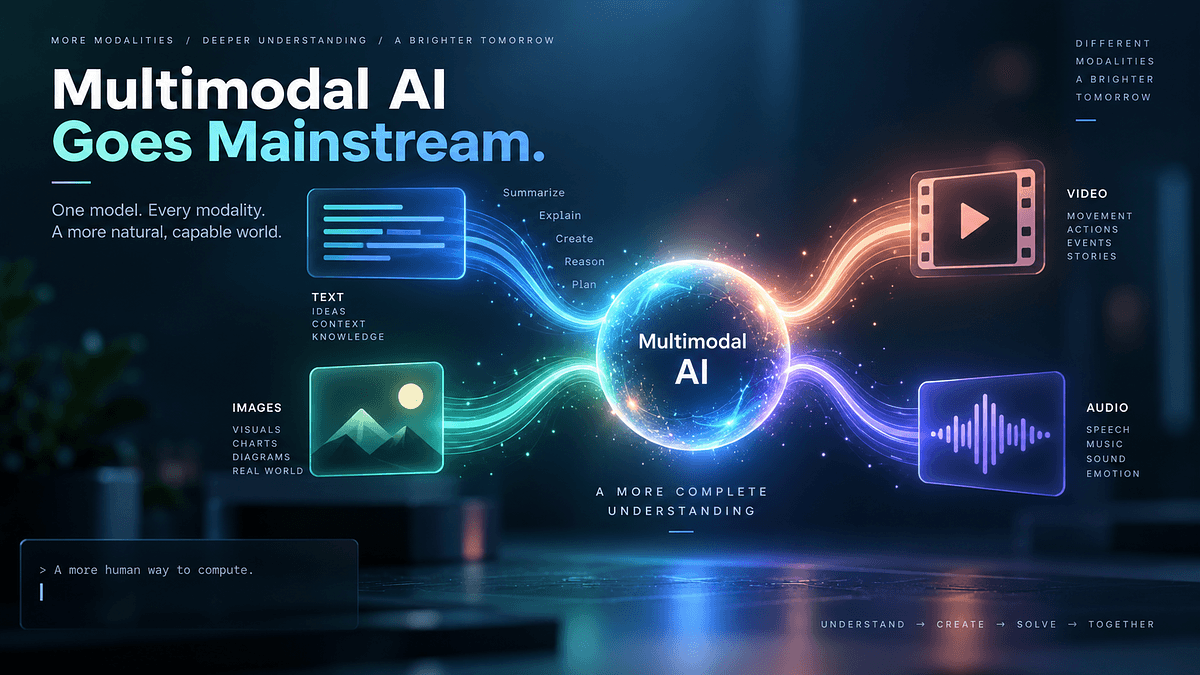
For years, calling a model multimodal AI 2026 largely meant it could accept an image alongside a text prompt and describe what it saw. That framing is now outdated. The current generation of frontier systems, led by Google's Gemini lineup, Anthropic's Claude family, and Alibaba's Qwen Omni series, increasingly reasons across text, image, video, and audio as a single connected stream rather than stitching separate specialist models together behind the scenes. Understanding how these three approaches differ matters for any team deciding where to invest in multimodal AI models compared side by side, because the architectural choices behind each one shape what they are actually good for in production.
Native multimodal models are built from the ground up to perceive multiple input types within a single neural network, rather than routing an image to one model and a transcript to another and merging the outputs afterward. This distinction has real consequences for consistency, because a model reasoning jointly across modalities can catch relationships a pipeline of separate tools would miss, such as a mismatch between what a speaker says in a video and what is shown on screen at the same moment.
Qwen's Omni family has pursued this native approach explicitly, with early text-first pretraining followed by mixed multimodal training so that unimodal text and image performance does not regress even as audio and video capabilities improve. Google has taken a similar unification path with Gemini Omni, an any-to-any system that reasons across text, image, audio, and video inputs to produce a single coherent output rather than treating each modality as an isolated processing stage.
This architectural shift toward true joint reasoning sets the stage for very different product philosophies at each of the three labs, which is where the practical differences start to show up.
Gemini Omni, unveiled at Google I/O in May 2026, represents Google's clearest statement yet about where multimodal AI is heading. Rather than positioning video generation as a separate specialty, Omni accepts text, images, audio, and video in any combination and reasons across all of them to generate or edit a single coherent video output through conversational, iterative instructions. The first variant, Omni Flash, replaced Google's earlier Veo model as the default video experience inside the Gemini app, producing roughly ten-second clips complete with synchronized audio.
What distinguishes Omni from a typical text image video audio AI pipeline is its conversational editing capability. A user can describe a change in natural language, such as swapping a character or altering a background, and the model applies that edit while preserving the rest of the scene, combining an understanding of physics with broader world knowledge to keep edits visually coherent. This stateful, multi-turn approach to video is a meaningful departure from single-shot generation tools.
Google has been careful to keep its dedicated Veo model running in parallel rather than retiring it outright, since Veo still leads on resolution and clip length while Omni wins on iteration speed and multimodal flexibility. That coexistence hints at a broader pattern across the industry: unified omni models are not necessarily replacing specialist tools, they are expanding what is possible in the same product.
Anthropic has taken a noticeably different path with Claude image analysis. Rather than expanding into video and audio generation, Claude has concentrated on making text and image reasoning exceptionally precise and reliable for professional and enterprise use. Claude Opus 5, released in July 2026, extends this focus with the ability to write custom vision code on the fly when it encounters an unfamiliar image type, converting raw pixels into structured geometry or clean extracted data rather than relying on a single fixed vision pipeline.
This shows up clearly in practical use cases such as reading engineering blueprints, inspecting scientific diagrams, and extracting structured data from charts and technical drawings, where accuracy and self-verification matter more than generative flair. Independent evaluations have found Claude models to be strong, dependable performers on visual question answering and document understanding tasks, even where they do not top every raw vision benchmark against faster-moving rivals.
The trade-off is scope. Claude has not pursued native audio or video generation the way Gemini and Qwen have, choosing instead to double down on dependable image and document reasoning within agentic and enterprise workflows. That specialization becomes a genuine strength once you consider where enterprise multimodal search and analysis workloads actually concentrate their volume.
Qwen's Omni model line has grown rapidly, moving from Qwen2.5-Omni into Qwen3-Omni and now into a substantially larger Qwen3.5-Omni model that scales to hundreds of billions of parameters. The model processes text, images, audio, and video while delivering real-time streaming responses in both text and natural speech, and it has posted state-of-the-art results on a majority of audio and video benchmarks among open-source models.
A distinguishing feature is Qwen's multilingual reach, supporting well over a hundred text languages alongside numerous speech input and output languages, which makes it an attractive open option for global deployments that cannot rely on English-first tooling. The newest Qwen3.5-Omni release has also introduced audio-visual grounding with script-level structured captions and precise temporal synchronization, along with an emerging capability the team calls audio-visual vibe coding, where the model writes code directly from audio-visual instructions.
Because Qwen Omni models are openly released, teams that need to self-host, fine-tune, or run inference at scale without per-token API costs have a genuinely competitive option rather than a token gesture toward openness. This makes Qwen a natural fit for the next question worth asking: what do these differences actually mean for how businesses deploy multimodal AI use cases day to day.
Enterprise multimodal search has emerged as one of the clearest beneficiaries of this progress, since teams can now query across scanned documents, product photos, recorded calls, and video footage using a single natural-language interface instead of maintaining separate search indexes per media type. AI video understanding models are increasingly used to summarize meeting recordings, flag compliance risks in customer calls, and generate structured metadata from raw video archives that would previously have required manual tagging.
For content and marketing teams, Gemini Omni's conversational video editing shortens iteration cycles that used to require specialized editors. For technical and scientific teams working with diagrams, blueprints, and structured documents, Claude's image analysis strengths reduce the manual review burden on visually dense reports. For organizations operating across many languages or needing to control deployment costs at scale, Qwen Omni's open weights and multilingual audio support offer a path that proprietary APIs cannot match on flexibility.
None of these systems are interchangeable, and choosing based on marketing claims alone is a common mistake. Video and audio generation remain computationally expensive, and clip lengths, resolution, and latency vary significantly across models and even across variants within the same family. Vision accuracy differs meaningfully by task type, and models that excel at general scene description do not automatically excel at technical document extraction or fine-grained object detection.
Data governance also deserves scrutiny, since multimodal inputs often carry more sensitive information than text alone, from faces in images to voices in audio recordings, and retention policies differ across providers and model tiers.
The multimodal AI 2026 landscape has moved well past simple image captioning into genuinely joint reasoning across text, image, video, and audio, with Gemini Omni, Claude, and Qwen Omni each carving out a distinct niche. Gemini leans into unified any-to-any video generation and editing, Claude concentrates on precise, verifiable image and document reasoning for professional workflows, and Qwen offers an open, multilingual alternative built for scale and self-hosting. The right next step for any team is to map specific use cases, whether that is video production, enterprise document search, or multilingual voice interfaces, against each model's actual strengths rather than assuming one system now does everything equally well.