
Every week, millions of people type a question into an AI chatbot and walk away disappointed with a vague, generic, or simply wrong answer. The tool did not fail them. The prompt did. Learning how to write AI prompts is quickly becoming one of the most valuable communication skills of this decade, on par with knowing how to write a clear email or a compelling pitch.
In 2026, AI models like ChatGPT, Claude, and Gemini are more capable than ever, but they still depend entirely on the quality of the instructions they receive. This prompt engineering guide breaks down exactly how these systems interpret language, what separates a weak prompt from a great one, and how you can apply proven techniques to get consistently useful results. Whether you are new to AI tools or looking to sharpen your skills, this article will walk you through the fundamentals step by step.
Before diving into techniques, it helps to understand what happens behind the scenes. When you submit a prompt, the AI model does not "know" what you want. It predicts the most statistically likely and contextually appropriate response based on the patterns in your wording, the structure of your request, and any examples or constraints you provide.
This means the model treats your prompt as the entire universe of context it has to work with. Ambiguity in your instructions becomes ambiguity in the output. Precision in your instructions becomes precision in the output. Once this mental model clicks, effective AI prompts stop feeling like magic and start feeling like a skill you can practice.
With that foundation in place, the next step is learning the core structure that almost every strong prompt shares.
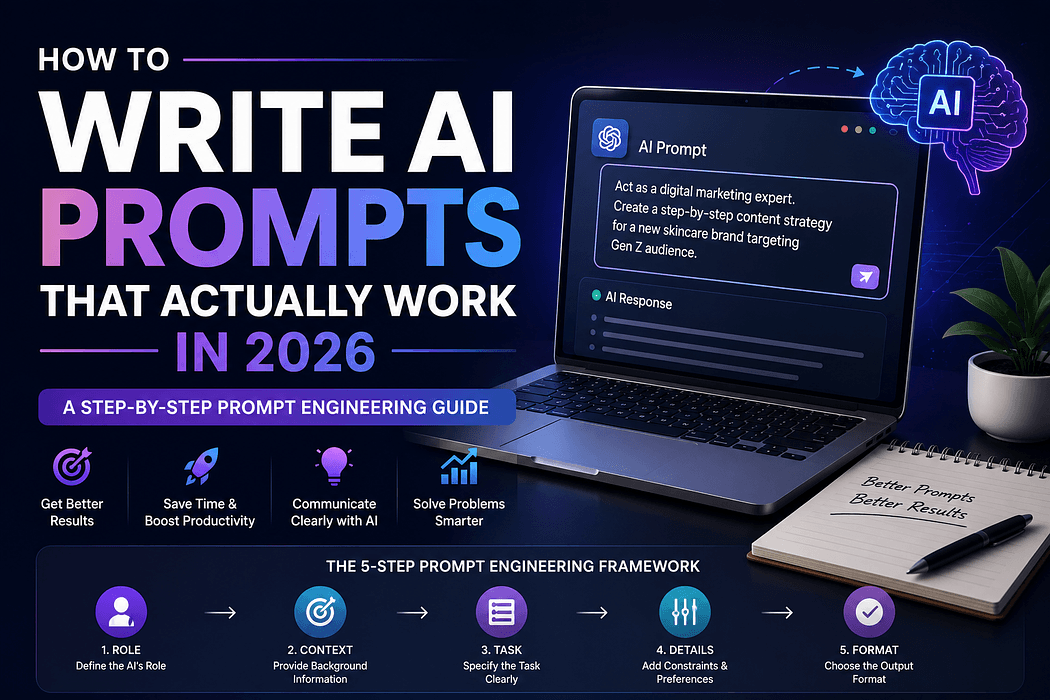
Most high-performing prompts share four building blocks, regardless of which model you are using.
Role: Tell the AI who it should act as, such as a financial analyst, a copywriter, or a Python developer.
Task: State clearly what you want done, using an action verb like summarize, compare, or generate.
Context: Provide relevant background information, audience details, or constraints the AI needs to succeed.
Format: Specify how you want the output structured, such as a table, a bullet list, or a specific word count.
Combining these four elements turns a vague request into a precise instruction. This structure works as a foundation for beginners and as a checklist for advanced users refining their prompt engineering for beginners routine into something more professional.
Seeing the difference in practice makes the concept easier to internalize.
Weak prompt: Write about marketing.
Strong prompt: Act as a marketing strategist. Write a 300 word blog introduction explaining email marketing benefits for small retail businesses. Use a friendly, conversational tone and include one statistic.
Weak prompt: Fix my code.
Strong prompt: Act as a senior Python developer. Review the following function for bugs and performance issues, then explain each fix in plain language before showing the corrected code.
Weak prompt: Help me plan a trip.
Strong prompt: Act as a travel planner. Create a five day itinerary for a solo traveler visiting Lisbon in October, with a moderate budget and a preference for walking tours and local food.
Notice how each strong version defines a role, a task, context, and a format. This same pattern applies whether you are experimenting with ChatGPT prompting techniques, working inside a Claude prompt guide, or testing Gemini AI prompts, since the underlying logic of clear instruction remains consistent across platforms.
Once the basic structure feels natural, several advanced techniques can push your results even further.
Chain of thought prompting asks the model to reason step by step before answering, which is especially useful for math, logic, or multi-part decisions. Simply adding a phrase like "think through this step by step" often improves accuracy noticeably.
Few-shot prompting involves giving the AI two or three examples of the input and output you want before asking your actual question. This is one of the most reliable AI prompt writing tips because it shows the model exactly what success looks like rather than describing it abstractly.
Iterative refinement treats the first response as a draft, not a final answer. Asking follow-up questions like "make this more concise" or "add a counterargument" often produces better results than trying to write the perfect prompt on the first attempt.
Constraint stacking layers multiple specific requirements, such as tone, length, audience, and format, into a single request to reduce the need for back and forth corrections.
These techniques form the backbone of AI prompt best practices used by professionals who rely on AI tools daily for research, writing, and coding work.
Even experienced users fall into familiar traps. Being too vague is the most common issue, since broad requests like "write something good" leave too much room for interpretation. Overloading a single prompt with too many unrelated tasks at once also tends to confuse the output.
Forgetting to specify format is another frequent error, especially when a specific length, tone, or layout genuinely matters to the final use case. Finally, many users abandon a prompt after one disappointing response instead of refining it, missing out on the significant improvement that even small edits can produce.
Investing time in this skill pays off quickly. Well-crafted prompts save time by reducing the number of regenerations needed to get a usable answer. They also improve accuracy, particularly for technical, financial, or research-based tasks where precision matters.
Strong prompting skills additionally make AI tools genuinely useful for professional work, from drafting reports to debugging code to summarizing lengthy documents. As more industries integrate AI into daily workflows, this ability to communicate clearly with a model becomes a practical, transferable skill rather than a niche technical trick.
Prompt engineering is powerful, but it is not a guarantee of perfect output. AI models can still misunderstand context, generate incorrect information, or reflect biases present in their training data. Reviewing and fact-checking important outputs remains essential, especially for professional or high-stakes content.
It is also worth remembering that different models respond differently to the same prompt structure. A technique that works well in one tool may need slight adjustments in another, so testing and comparing results across platforms is a valuable habit for anyone serious about this skill.
Learning how to write AI prompts is less about memorizing tricks and more about developing a clear communication habit. By defining a role, a task, relevant context, and a desired format, and by applying techniques like chain of thought reasoning and few-shot examples, you can turn generic AI responses into consistently useful, tailored output.
As AI tools continue to evolve throughout 2026, the fundamentals covered in this guide will remain relevant even as new features and models emerge. Start by rewriting one of your recent prompts using the structure above, compare the results, and build from there. The more deliberately you practice, the more reliably these tools will work for you.