
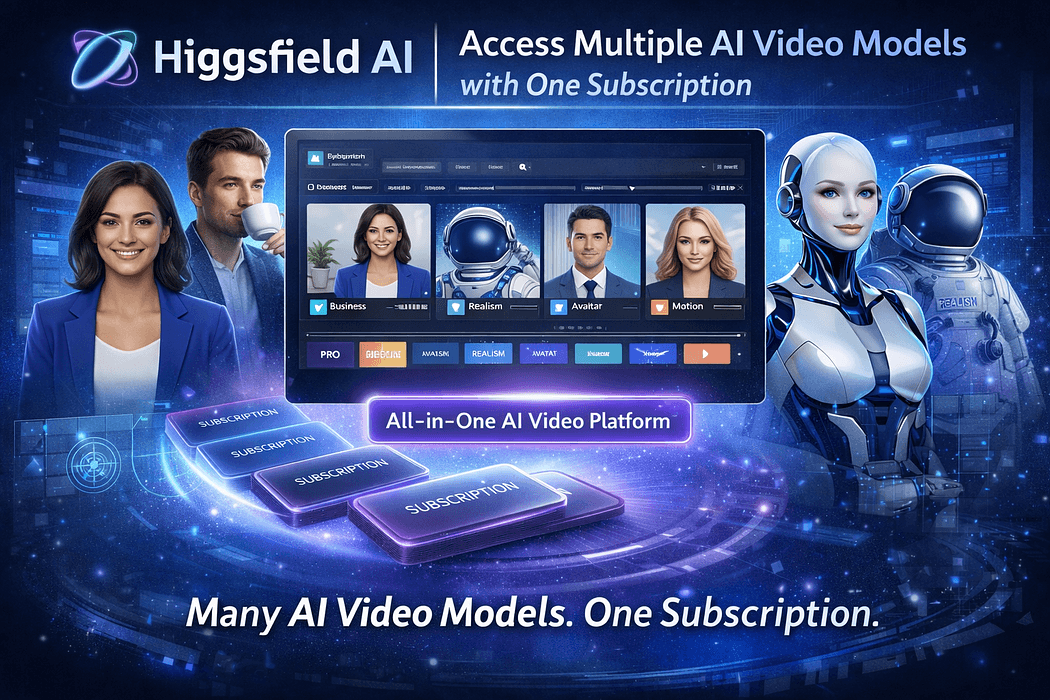
Here is a situation every serious AI video creator knows too well. You have got one subscription for Sora when you need photorealism, another for Kling when you need character consistency, a third for Veo when you want cinematic quality, and somehow you are supposed to manage credits, logins, and wildly different interfaces across all of them. It is expensive, it is exhausting, and it breaks creative flow every single time you switch. Higgsfield AI was built specifically to fix that problem, and it is doing it in a way that is genuinely worth paying attention to.
Higgsfield AI is a San Francisco-based creative platform founded in 2023 by Alex Mashrabov, who previously served as Head of Generative AI at Snap, where he invented AR lenses used by hundreds of millions of people daily. Rather than building yet another proprietary AI model, Higgsfield took a different strategic bet: integrate the best models in the world into a single workspace and build professional-grade creative controls on top of them.
The result is a platform that currently gives you access to Sora 2, Google Veo 3.1, Kling 3.0, Wan 2.5, Minimax, and more, all from a single workspace without switching tabs or managing separate accounts. Think of it like a streaming platform, but instead of shows, you are accessing the world's most powerful AI video generators. One subscription, one interface, every model.
The company has secured eight million dollars in seed funding led by Menlo Ventures and is generating approximately four million videos per day on its platform, a number that signals genuine scale rather than niche adoption. Its partnership with OpenAI, announced via the official OpenAI case study page, has made Higgsfield one of the most closely watched players in the AI video creation tools space.
Here is something most AI video reviews do not tell you: no single model is best at everything. Sora 2 leads on photorealistic motion and continuity. Veo 3.1 delivers exceptional cinematic emotional quality. Kling 3.0 excels at character consistency across multi-shot sequences. Wan 2.5 brings strong audio-driven generation. Each has a different creative superpower, and experienced creators learn to route their projects accordingly.
Higgsfield's internal Prompt Team ran a full comparison of all five models available on the platform and concluded exactly this: there is no winner, just different tools for different jobs. What Higgsfield provides is the ability to make that routing decision without leaving the platform. You can generate the same clip in Sora 2 and Veo 3.1 simultaneously, compare outputs side by side, and choose the best result. That workflow is simply not possible anywhere else right now.
Third-party reviews have benchmarked Higgsfield's cost efficiency at four times more generations than competitors at equivalent budgets, primarily because the 75 dollar monthly plan bundles access to models that would individually cost significantly more via direct subscriptions. The math is straightforward: Sora 2 alone via ChatGPT Pro costs 200 dollars per month. Veo 3.1 via Google is similarly priced. Getting both, plus Kling, Wan, and Minimax, for 75 dollars per month through Higgsfield is a genuinely different value proposition.
If there is one feature that explains why filmmakers and serious creators are choosing Higgsfield over just subscribing directly to individual model providers, it is Cinema Studio. This is Higgsfield's flagship professional video environment, and it does something no other AI video platform currently offers at this level: it simulates real optical physics.
Before you even generate, you choose a virtual camera body, a lens type, and a focal length. Want that shallow depth of field look of an 85mm portrait lens? Set it. Want the gritty texture of 16mm film combined with modern anamorphic sharpness? Stack them. Higgsfield calls this its Bespoke Optical Stack, and it means you are directing the camera before you are directing the AI.
Cinema Studio also supports multi-axis motion control, letting you stack up to three simultaneous camera movements in a single generation. A slow dolly forward combined with a subtle upward tilt and a focus pull to a background subject is a single prompt setup in Cinema Studio. Reviewers testing the platform described outputs as having depth, smooth optical-quality push-ins rather than digital zooms, and motion that reads as physically real rather than algorithmically generated. Over 70 presets including Bullet Time, Crash Zoom, and 360 Rotation make getting started fast even without deep cinematography knowledge.
Higgsfield's Sora 2 Trends feature analyzes viral short-form social videos at scale using GPT-4.1 and GPT-5, distilling what makes them perform into a library of repeatable video presets. Around 10 new presets are added daily as trends evolve, and older ones are retired when engagement drops. Videos generated using trending presets show a 150 percent increase in share velocity and roughly 3 times higher cognitive capture compared to Higgsfield's own earlier baseline, based on downstream engagement data.
Click-to-Ad takes this a step further for product marketers. Paste a product URL, and Higgsfield uses GPT-4.1 to extract brand intent and visual anchors from the page, maps the product to a trending preset, and generates a social-ready ad video using Sora 2 without you writing a single prompt. For e-commerce teams running multiple product campaigns simultaneously, this removes the creative bottleneck that previously required a dedicated video production workflow.
Higgsfield Speak lets you turn a selfie or uploaded portrait into a talking avatar with frame-accurate lip sync. Upload your face, write your script, and the system generates a video of your likeness delivering the words with synchronized lip movement and natural expression. The UGC Builder, powered by Veo 3, extends this for advertising by generating hyper-realistic talking-head videos suited to testimonial and user-generated content ad formats.
Launched in 2026, Higgsfield Assist is a GPT-5-powered creative copilot built directly into the platform. It suggests prompts, recommends which model to use for a given creative goal, and proposes refinements to outputs in plain language. For creators who find prompt engineering a barrier, Assist meaningfully lowers the technical floor without removing the ceiling for those who want granular control.
Higgsfield is strongest for three types of users. Social media creators who need trend-aligned short-form content at volume will get the most immediate value from Sora 2 Trends and the preset library. Marketing teams running product video campaigns will find Click-to-Ad and the UGC Builder genuinely useful for reducing production time and cost. And filmmakers or serious video storytellers who want professional camera control over AI-generated footage will find Cinema Studio is unlike anything else currently available.
It is less well suited for long-form content creators, since the maximum clip length sits at 10 to 20 seconds depending on the model and plan. It is also not the strongest choice for users who only ever need one specific model and do not need the breadth of the platform. If all you need is Kling 3.0, subscribing to Kling directly may make more sense than paying for a platform built around multi-model access.
Community reviews on Trustpilot and G2 reveal a consistent pattern of complaints worth knowing before you subscribe. The most frequent issue centers on subscription transparency. Several users report that plans marketed as unlimited turned out to carry usage caps that were not clearly communicated at signup. Credit burn rates on complex generations can be high, and the free tier is genuinely limited to one video and one image, which is barely enough to evaluate the platform properly.
Generation speed varies across models, and some users report inconsistent output quality, particularly when prompts include fine details that the model partially ignores. Occasional content moderation blocks are also flagged by creators working on edgier or more abstract concepts. The platform feels slightly fragmented in places, a natural side effect of aggregating multiple underlying models with different interfaces and behaviors.
Geographic availability is not fully global yet, which affects some users outside North America and Western Europe. And as a private company without a long publicly traded track record, the platform carries the dependency risk that comes with any high-growth startup. Building a core production workflow around any single AI tool involves vendor risk, and Higgsfield is no exception.
The fragmented AI video tool landscape is a real problem, and Higgsfield's answer to it is both smart and practically useful. The multi-model workspace eliminates platform switching. Cinema Studio gives professional creators camera control that genuinely changes the quality ceiling of AI-generated footage. Sora 2 Trends and Click-to-Ad solve specific, real workflow problems for social and marketing teams. And the cost efficiency argument at 75 dollars per month for access to models that would otherwise cost hundreds of dollars individually is hard to argue against.
The free tier gives you exactly one video and one image, which is not really enough to make an informed decision. If you are serious about evaluating the platform, committing to one month on a paid plan and testing it against your actual production workflow is the right approach. Generate content across two or three different models, compare them side by side, and test the Cinema Studio on a project that matters to you. That hands-on evaluation tells you far more than any review can.
The best AI video platform is not the one with the best single model. It is the one that lets you use the right model for the right job without making you pay for five subscriptions or manage five different tools. That is what the Higgsfield AI video platform is trying to be, and right now, it is closer to solving that problem than anyone else in the market.