
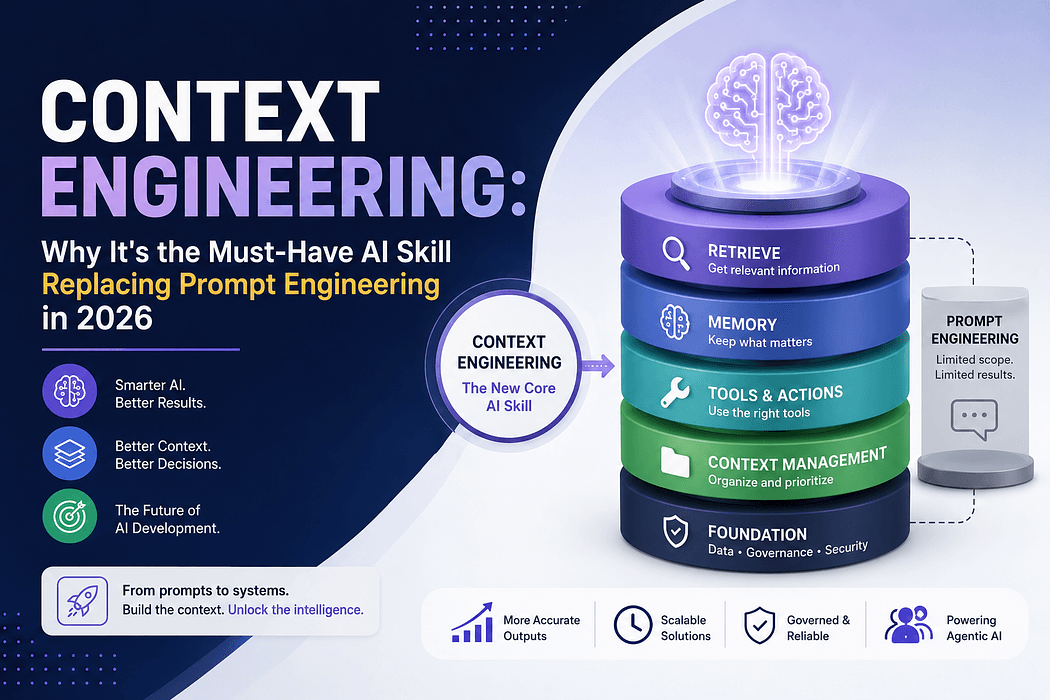
Hey friend, remember when we all scrambled to master prompt engineering back in 2023 and 2024? Those clever tricks to coax the best responses out of ChatGPT felt like magic. Fast forward to 2026, and the game has completely changed. Prompt engineering isn't exactly dead, but it's no longer the star of the show. Context engineering has taken center stage, and if you're working with AI seriously, this is the skill you need to level up right now.
Have you noticed how simple prompts that worked great last year now deliver mediocre or inconsistent results in complex projects? That's because today's AI systems, especially agentic ones, operate in dynamic environments with massive context windows. They need more than just the right words. They need the right information ecosystem.
Prompt engineering focused on crafting the perfect input text. You would spend hours refining phrasing, adding examples, or using techniques like chain-of-thought to guide the model. It was all about the message you sent.
Context engineering takes a much broader approach. It involves designing and managing the entire information environment that surrounds the AI model. This includes what data gets retrieved, how memory is handled, tool integrations, conversation history, and the overall architecture that feeds the model relevant information at the right time.
Think of it like this: prompt engineering is like writing a great script for an actor. Context engineering is building the entire stage, props, lighting, and supporting cast so the actor can perform at their best no matter what scene comes up.
In practical terms, while a prompt might say "Analyze this sales report," context engineering ensures the model has access to the latest CRM data, historical trends, team notes, market conditions, and previous analysis summaries without you cramming everything into one massive prompt.
Models have gotten dramatically better at understanding intent. The fragile genie that needed perfect wording is now a capable colleague. But the real shift came with agentic AI systems and long-context models.
AI agents in 2026 don't just respond once. They plan, use tools, maintain memory across sessions, and handle multi-step workflows. A 50-page prompt becomes useless compared to a smart retrieval system that pulls only relevant context.
Long-context AI models with windows reaching millions of tokens changed everything. Suddenly, you could feed entire codebases or document libraries, but success depended on how well you structured and prioritized that information. Poor context management leads to the "lost in the middle" problem where key details get buried and ignored.
Enterprises discovered that prompt tweaks delivered diminishing returns in production. Surveys in 2026 show that most IT leaders now see prompt engineering alone as insufficient for scaling reliable AI.
Agentic AI represents the big leap forward. These aren't simple chatbots. They are autonomous systems that pursue goals, make decisions, and coordinate actions.
Context engineering shines here because agents need consistent, relevant information throughout their operations. Good context management includes:
- Dynamic retrieval from knowledge bases and vector stores
- Memory systems that compress and recall important details
- Tool orchestration with proper state management
- Governance layers ensuring data freshness and accuracy
For example, imagine building a customer support agent. With basic prompting, it might hallucinate policy details. With proper context engineering, it retrieves the latest policy documents, customer history, similar past cases, and compliance rules in real-time.
Let's look at a practical case. A marketing team wants AI to generate campaign ideas.
Old approach (prompt engineering heavy): They write a massive prompt with brand guidelines, past campaigns, audience data, and competitor analysis all stuffed in. Results are hit-or-miss, and updating any information requires rewriting the whole prompt.
New approach (context engineering): They build a system where the model gets a lightweight goal prompt, but the context layer automatically pulls relevant brand assets, recent performance data, market research, and creative examples based on the specific request. The agent can even query tools for current trends.
The difference is night and day. Outputs become more consistent, current, and creative because the model works with quality context rather than a static wall of text.
In enterprise AI implementation, companies use context management for workflow automation. Legal teams have systems that pull relevant case law, contracts, and regulations dynamically. Developers get agents that understand the full codebase architecture without token overload.
The advantages go beyond better outputs. Context engineering enables:
- More reliable AI agents that maintain performance over long tasks
- Better scalability across different use cases without constant prompt rewriting
- Improved security and compliance through governed context flows
- Reduced hallucinations because models ground responses in real, curated data
- Faster iteration since changes to knowledge sources update automatically
For professionals, this skill positions you perfectly for the future of AI. Roles are shifting from prompt tweakers to context architects who design information systems for AI.
Context engineering isn't without challenges. Managing large context windows still has costs, both computational and financial. You need solid data governance. Poorly structured knowledge bases can lead to worse results than simple prompting.
There's also a learning curve. It combines skills from software engineering, information architecture, and domain expertise. Start small by focusing on retrieval-augmented generation (RAG) pipelines before building full agent systems.
Models can still get overwhelmed with irrelevant context, so techniques like ranking, summarization, and compaction remain crucial.
Ready to make the switch? Begin by auditing how information flows to your current AI tools. Map out what data matters for different tasks. Experiment with vector databases and simple retrieval systems.
Focus on understanding your domain deeply. The best context engineers know both the technology and the business problems intimately.
The future of AI prompting isn't about dying prompts. It's evolving into sophisticated context management that makes AI truly useful at scale.
As we move through 2026, the winners won't be those with the fanciest prompts. They'll be the ones who master building the right information environment for their AI systems.
What do you think? Have you started experimenting with context techniques in your workflows yet? The shift is happening now, and getting ahead on context engineering could give you a serious advantage this year.