
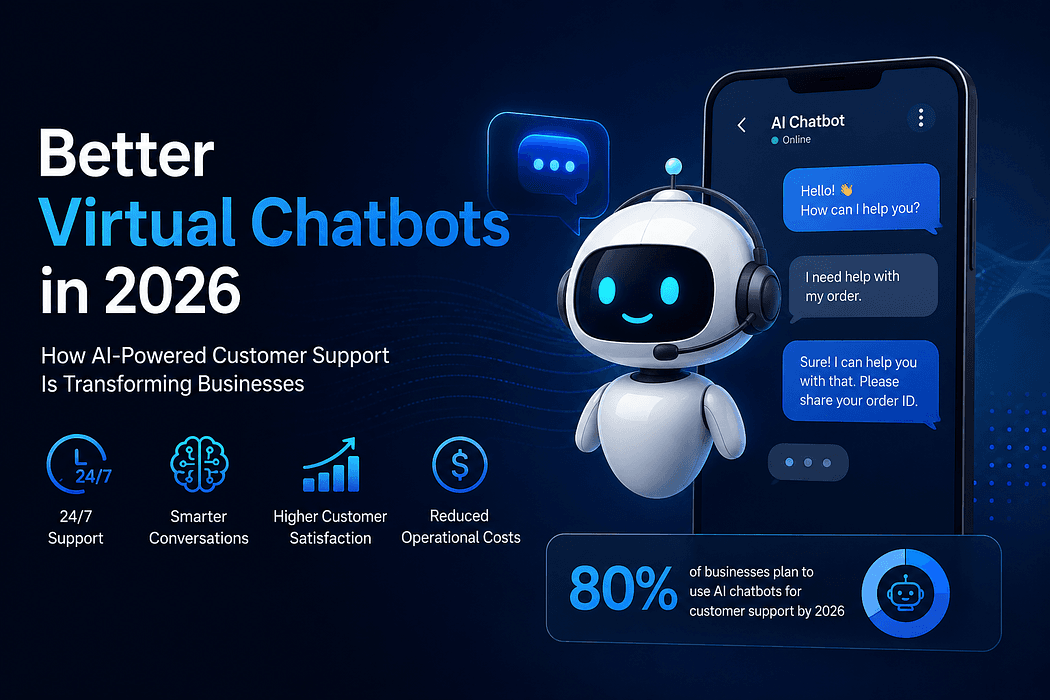
Customer expectations have shifted faster than most support teams can keep up with, and AI virtual chatbots are the reason why. What began as clunky, rule-based scripts that could barely handle a password reset has evolved into conversational systems capable of resolving complex, multi-step issues without a human ever stepping in. In 2026, this shift is no longer experimental. It is infrastructure. Businesses across banking, retail, telecommunications, and healthcare are rebuilding their support operations around AI customer support chatbots, and the numbers behind this transition are difficult to ignore. This article breaks down what has changed, why it matters, and how organizations can use these tools effectively without falling into the traps that still trip up many early adopters.
Older chatbots operated on decision trees. A customer typed a question, the system matched keywords, and the response came from a fixed menu of pre-written answers. The moment a query fell outside that script, the bot looped, frustrated the customer, or handed off to a human anyway. Conversational AI, powered by large language models, works differently. It interprets intent, holds context across a multi-turn conversation, and adapts its tone based on the situation.
This distinction shows up clearly in resolution data. Traditional self-service tools resolve roughly 14 percent of issues on their own, while AI-native platforms are now resolving between 55 and 70 percent of tier-one issues without any human involvement. That is not a marginal improvement. It represents a fundamentally different category of tool, one that customer experience leaders are treating as core infrastructure rather than a side project.
From here, it helps to look at where these systems are actually being deployed and what tasks they are taking on.
Modern intelligent chatbots parse ambiguous, informal, and multilingual input with a level of nuance that older systems never approached. A customer typing broken English, using slang, or switching topics mid-sentence can still be understood and routed correctly. This matters enormously for global businesses managing support across dozens of languages and time zones.
Today's business AI chatbots do more than answer questions. They check order status, initiate refunds, reschedule appointments, and update account details by connecting directly to backend systems through APIs. This turns the chatbot from a conversational interface into an operational agent capable of completing entire workflows independently.
Because these systems retain conversation history and account context, they can personalize responses in ways that feel less like a script and more like a knowledgeable representative. AI-powered personalization has been linked to measurable revenue gains, since customers who feel understood are more likely to complete a purchase or renew a service rather than abandon the interaction.
Once a business understands what these systems can do, the next question is where they deliver the most value in practice.
A mid-size online retailer facing seasonal order spikes can deploy an AI support agent to handle shipping inquiries, returns, and size or fit questions around the clock. Instead of scaling a seasonal support team, the business routes only complex disputes to human agents, cutting response times while controlling labor costs.
Banks are among the most aggressive adopters of AI customer service automation, given the volume of repetitive queries around balances, transaction disputes, and card activation. AI in this sector is also projected to meaningfully reduce operational expenditure while improving compliance consistency, since automated responses can be standardized and audited more easily than variable human phrasing.
Telecommunications and healthcare organizations report some of the highest AI adoption rates of any sector, largely because both fields deal with high call volumes tied to account management, appointment scheduling, and troubleshooting. A 24/7 AI chatbot support layer reduces wait times during peak periods, which is often when patient or customer frustration is highest.
These examples point toward a broader pattern: the businesses seeing the strongest results are the ones matching the right level of automation to the right type of query, rather than trying to automate everything at once.
Cost efficiency is the most frequently cited driver. Each AI chatbot interaction typically costs a fraction of what a human-handled interaction costs, and conversational AI is projected to meaningfully reduce contact center labor costs industry-wide this year. Beyond raw cost savings, businesses report faster resolution times, since AI-native platforms now average well under three minutes per handled issue compared to traditional benchmarks.
Availability is another major factor. Round-the-clock coverage without staffing three shifts changes the economics of global support entirely. Consistency also matters more than many teams initially expect. Unlike human agents, whose responses vary with fatigue, training gaps, or mood, a well-tuned chatbot delivers the same quality of answer at 3 a.m. as it does at 3 p.m.
Finally, there is a data advantage. Every conversation an AI support agent handles generates structured data about recurring pain points, product gaps, and customer sentiment, giving product and support teams a continuous feedback loop that manual ticket review never provided at the same scale.
These benefits are real, but they come with caveats that any team evaluating this technology should weigh carefully.
Despite the momentum, customer trust has not caught up with deployment speed. A significant share of customers report wanting companies to scale back their reliance on AI in support contexts, which signals a real gap between what businesses are rolling out and what customers currently feel comfortable with. This gap tends to widen when chatbots are deployed for emotionally sensitive issues, such as billing disputes or service cancellations, where customers strongly prefer human judgment.
Accuracy also remains an active concern. Large language models can generate plausible but incorrect responses, particularly on edge cases outside their training or retrieval scope. Businesses deploying AI virtual chatbots need strong escalation paths, clear disclosure that the customer is speaking with an AI, and human oversight for high-stakes categories like healthcare guidance or financial advice.
Integration complexity is another underappreciated hurdle. A chatbot is only as capable as the systems it connects to. Poor integration with order management, CRM, or ticketing platforms limits even the most advanced conversational AI to answering generic questions, which undercuts the entire value proposition.
With both the upside and the risks in view, the path forward becomes clearer for businesses deciding how to move.
Businesses with high support ticket volume, repetitive query patterns, or global customer bases stand to gain the most immediate value from AI customer support chatbots. Enterprises already running structured knowledge bases or established support workflows will see faster returns, since the AI has clean, well-organized information to draw from. Smaller businesses without that groundwork may need to invest in documentation and process mapping before automation delivers strong results, since a chatbot trained on messy or outdated information will simply automate inconsistency at scale.
The trajectory for AI virtual chatbots in 2026 points firmly toward deeper integration, broader autonomy, and higher customer expectations. Businesses that treat these systems as strategic infrastructure, backed by clean data, clear escalation paths, and ongoing oversight, are seeing measurable gains in resolution speed, cost efficiency, and customer satisfaction. Those still running legacy scripted bots are increasingly falling behind on both experience and economics. The technology has matured well past novelty status. What remains is the discipline of implementing it thoughtfully, matching automation to the right use cases, and keeping human judgment available where it still matters most.