
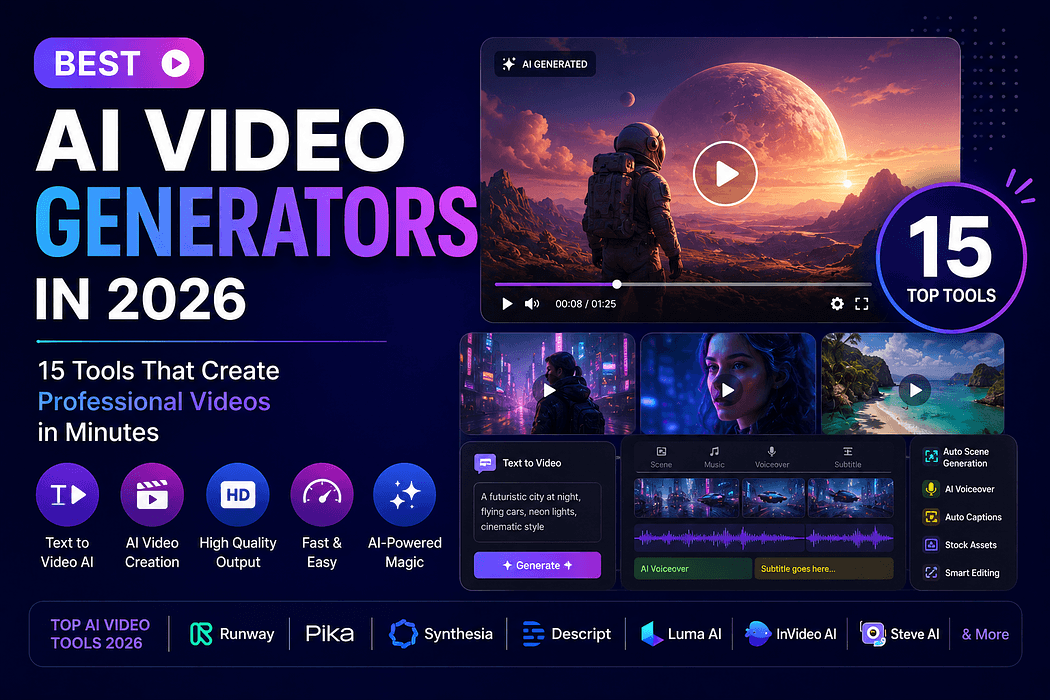
Video production used to require a camera crew, editing software, and days of turnaround time. In 2026, a well-crafted text prompt can produce broadcast-quality footage in under a minute. The best AI video generators now combine cinematic realism, synchronized audio, and precise creative control, changing how marketing teams, filmmakers, and solo creators approach production. This guide breaks down fifteen leading platforms, what sets each apart, and how to choose the right one for your workflow.
The jump from novelty to production-ready tool happened faster than most predicted. Improvements in diffusion architectures, longer context windows for prompt adherence, and native audio generation pushed output quality past the uncanny valley for many use cases. Today's AI video generator options are judged not just on visual fidelity but on consistency across shots, licensing terms, and how well they fit into existing creative pipelines.
That shift matters because it separates casual experimentation from tools teams can actually ship with. With that context established, here is how the top fifteen tools stack up.
Google Veo 3.1 remains a benchmark for realism and physical plausibility, with native audio generation that syncs dialogue, ambient sound, and music to the visual scene. It works inside Google Flow, offering text-to-video, image-to-video, and multi-reference "ingredients to video" workflows for creators who need tight steerability.
OpenAI Sora 2 Pro focuses on longer, narrative-driven sequences with advanced world simulation and synchronized dialogue, making it a strong choice for storytelling-heavy projects rather than short social clips.
Kling AI, now in its 3.0 and 2.6 releases, has built a reputation for photorealistic human characters, natural movement, and strong lip-sync accuracy, which makes it a favorite for dialogue-driven and social-first content.
Seedance, spanning versions 1.5 Pro through 2.5, delivers stylistically fluid, mood-driven visuals with native audio, and is often praised for cinematic storytelling at a lower per-second cost than premium alternatives.
Runway Gen-4.5 continues to lead on camera control, offering motion brushes and precise pan, tilt, and zoom handling that appeals to teams with dedicated motion designers, though its free tier is limited.
Rounding out the model tier are Luma Ray3, known for elegant visual output and a polished interface; PixVerse 5.5, suited to bold, anime-inspired, and highly stylized short clips; and Grok Imagine, which leans into creative, emotionally driven visual generation.
Beyond raw model quality, several platforms focus on workflow, collaboration, and multi-model access rather than a single proprietary engine.
Hedra stands out for agent-led production and collaborative visual work, letting teams orchestrate multiple generation steps within one interface. FLORA targets design and agency systems that need deeper technical control, while Dreamina is built for high-volume social experimentation with fast iteration cycles.
ComfyUI Cloud gives technically minded teams full pipeline control through node-based workflows, an approach that suits studios building custom generation chains rather than relying on a single vendor's defaults.
ImagineArt AI Video Generator takes a different approach entirely, aggregating access to Kling, Veo, Seedance, and PixVerse under one subscription. This model-agnostic strategy appeals to teams who want flexibility without committing to a single engine's strengths and weaknesses.
Not every project needs frontier-level realism. InVideo pulls relevant stock footage and pairs it with AI-generated voiceovers and background music, producing polished short clips from a simple text description in under two minutes. HeyGen and Synthesia remain strong choices for avatar-led corporate and training content, where a consistent presenter matters more than cinematic camera work.
For creators testing concepts before committing budget, Wan AI and OpenArt offer usable free tiers that support short cinematic landscape shots, character dialogue scenes, and stylized motion effects without upfront cost.
Choosing among these fifteen options comes down to three questions: what output length do you need, how much creative control matters, and what is your budget per clip.
Marketing teams producing short-form social content generally get the best return from PixVerse, Dreamina, or Kling, all of which prioritize speed and stylistic range over long-form narrative depth. Filmmakers and agencies working on branded content benefit more from Veo 3.1 or Runway Gen-4.5, where camera precision and physical realism justify a higher per-second cost.
Corporate training and internal communications teams should look toward HeyGen or Synthesia, since avatar consistency and script-to-video speed outweigh cinematic ambition in that context. Technical teams building repeatable, customized pipelines are better served by ComfyUI Cloud or FLORA than by a single-model consumer app.
Regardless of which platform a team chooses, the advantages of modern AI video creation tools are consistent. Production timelines shrink from days to minutes. Iteration becomes nearly free, letting creative teams test five concepts instead of committing to one. Native audio generation removes a separate post-production step that used to require dedicated sound design.
Multi-model platforms like ImagineArt also reduce vendor lock-in, letting teams switch engines mid-project if a particular model handles a specific shot better than another.
These tools are not without trade-offs. Clip length remains a real constraint; many top models still cap generations at six to ten seconds, which limits storytelling flexibility and requires stitching multiple clips together for longer sequences. Free tiers are often one-time credit allotments rather than renewing plans, so teams should budget for paid tiers once past the experimentation phase.
Licensing and usage rights also vary significantly between platforms, particularly for commercial use, so it is worth confirming terms before building a campaign around any single tool. Finally, prompt adherence and character consistency still differ meaningfully across models, meaning the "best" AI video generator is genuinely use-case dependent rather than universal.
The AI video creation category has moved decisively from experimental novelty to core production infrastructure. Veo 3.1 and Sora 2 Pro anchor the high end for realism and narrative depth, Kling and Seedance offer strong value for dialogue and stylized content, and multi-model platforms like ImagineArt and Hedra give teams flexibility without vendor lock-in. The right next step is to test two or three tools against the same prompt, compare output quality and cost per clip, and build a workflow around whichever combination best fits your creative goals and budget.