
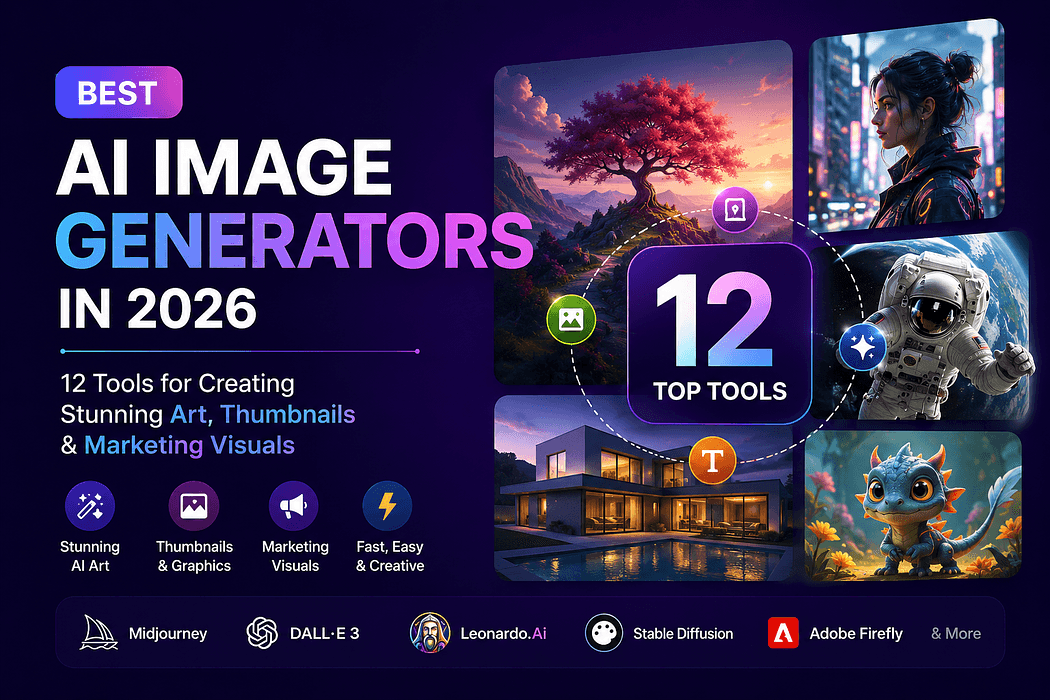
The AI image generation market has moved well past its novelty phase. What began as a handful of experimental diffusion models has matured into a crowded field of specialized platforms, each optimized for a distinct workflow, from photorealistic product shots to typography-heavy marketing posters. For designers, marketers, and content creators evaluating the best AI image generators in 2026, the challenge is no longer whether these tools produce usable output, but which tool fits a specific production pipeline. This guide breaks down twelve leading platforms, their technical strengths, and the use cases where each one delivers the most value.
Before comparing individual tools, it helps to understand the criteria that separate a capable AI art generator from a merely adequate one. Image fidelity and prompt adherence remain the baseline expectations, but professionals increasingly weigh additional factors. These include editing precision, reference-image consistency for branded assets, licensing terms for commercial use, and API access for embedding generation into existing design workflows. With that framework in place, here is how the current generation of text to image AI tools stacks up.
GPT Image 2 currently leads independent blind-vote benchmarks, including the Artificial Analysis Image Arena, where it debuted with an unusually wide lead over the next-ranked model. Its token-by-token transformer approach, rather than traditional diffusion, contributes to stronger instruction-following on complex, multi-element prompts. This makes it a strong default choice for teams that need reliable output on the first attempt.
Nano Banana Pro, built on Google's Gemini image architecture, ranks close behind and pairs strong photorealism with fast inpainting and image-to-image editing. Its speed advantage over earlier Gemini image models makes it well suited to iterative creative work where designers refine a concept across many passes rather than generating a single final image.
Midjourney V8.1 remains the preferred choice among illustrators and concept artists who prioritize painterly, stylistically distinctive output over strict photorealism. Its aesthetic sensibility is difficult to replicate with prompt engineering alone, which is why many creative studios keep it in their toolkit even as competitors close the technical gap.
For marketing teams, brand consistency across assets often matters more than raw image quality. Seedream 4, developed by ByteDance, addresses this directly by supporting up to six reference images in a single generation, allowing a brand's color palette, mascot, or product design to persist across an entire campaign. Its 4K output also reduces the need for separate upscaling steps.
Ideogram 3 remains the standout choice for typography-driven work such as logos, posters, and social media graphics. Where most AI thumbnail generator tools still struggle with legible text rendering, Ideogram 3 handles stylized lettering with a level of accuracy that has made it a default for advertising teams.
Adobe Firefly continues to serve enterprises that require clear commercial licensing. Because Firefly is trained exclusively on licensed and public domain content, it offers indemnification and ownership clarity that matters for regulated industries and large publishers.
Flux.2, from Black Forest Labs, is built specifically for production pipelines. Its open-weight tiers, ranging from a lightweight Schnell variant to a high-fidelity Pro model, give development teams flexibility to balance cost against output quality, while preserving character and style consistency across iterative edits.
Not every workflow demands frontier-level fidelity. Google's Imagen 4 favors speed over exhaustive detail, making it a practical choice for early-stage concept testing where a team needs to explore many directions quickly before committing design resources to a final direction.
Reve AI distinguishes itself through accessibility rather than raw benchmark scores. Its conversational editing feature lets users refine an image through plain-language feedback, similar to directing a human designer, which lowers the learning curve for teams without dedicated prompt engineering expertise.
Canva's integrated AI generator has become a favorite among small businesses and solo creators because it combines generation with the platform's existing design and templating tools. This tight integration reduces the number of separate applications needed to go from a raw AI image to a finished, on-brand asset.
Leonardo.Ai has built a strong following in game development and asset-heavy production, offering prompt history tracking and curated style libraries that support consistent visual output across large batches of assets.
Recraft V4.1 rounds out the list as a strong option for vector-style graphics and design system assets, an area where raster-focused diffusion models traditionally underperform.
Pricing structures vary significantly across this category. Open-weight models such as Flux Schnell and Stable Diffusion variants can run locally at no per-image cost, while frontier hosted models typically charge between one and ten cents per generation. Licensing terms also differ meaningfully; not every platform offers the same guarantees around training data provenance, which matters for organizations concerned about copyright exposure. Output consistency across a session can vary as well, so teams handling high-volume campaigns should test reference-image handling before committing to a single platform.
There is no single best AI image generator for every situation in 2026. GPT Image 2 and Nano Banana Pro lead on general-purpose quality and speed, Ideogram 3 and Seedream 4 solve specific branding and typography challenges, and tools like Reve AI and Canva prioritize accessibility over raw benchmark performance. The most effective approach for most teams is to match the tool to the task rather than searching for one platform that does everything well. Testing two or three of these options against real production prompts remains the most reliable way to determine which best AI art tools of 2026 fit a given workflow.