
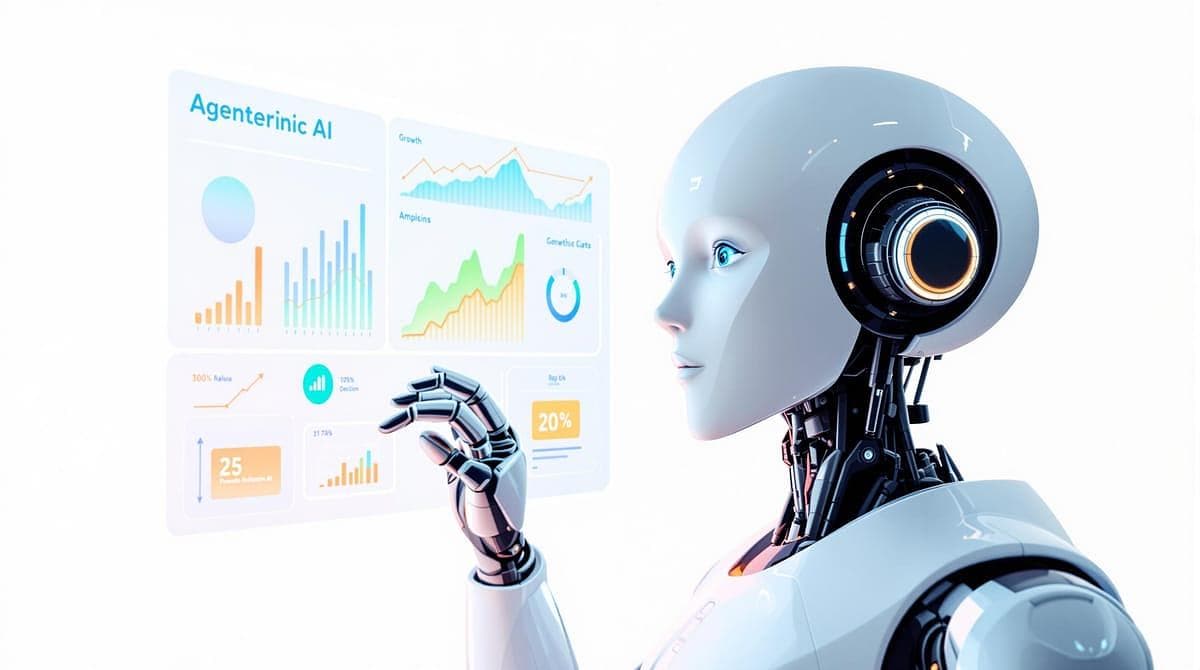
The transition from AI as a passive tool to AI as an active participant in enterprise workflows is no longer a theoretical prospect — it is happening at scale. AI agents 2026 represent a categorical shift in how organizations automate, analyze, and execute work. These are not chatbots that respond to queries; they are autonomous systems that perceive goals, formulate plans, use external tools, and complete multi-step processes with minimal human direction. For technology leaders and practitioners navigating this shift, the decisions made now about architecture, governance, and deployment strategy will determine competitive positioning for years to come.
AI agents are systems that combine advanced AI intelligence with the ability to use tools and take actions on your behalf. Unlike traditional AI that might just summarize a document, an agent understands the goal, creates plans, and executes multi-step tasks across different applications. This represents a fundamental leap from an "add-on" approach to an "AI-first" process — a movement from instruction-based computing to intent-based computing, where users state a desired outcome and the agent determines how to deliver it.
The market data reflects the urgency of this shift. Industry analysts project the agentic AI market will surge from $7.8 billion today to over $52 billion by 2030, while Gartner predicts that 40% of enterprise applications will embed AI agents by the end of 2026, up from less than 5% in 2025. This rate of adoption is compressing what would historically be a decade-long technology cycle into a span of months.
IBM's Kate Blair, who leads the company's BeeAI and Agent Stack initiatives, stated that 2026 is when multi-agent system patterns are going to come out of the lab and into real life. The protocol infrastructure that makes this possible — including Anthropic's Model Context Protocol (MCP), Google's Agent-to-Agent protocol, and IBM's ACP — is maturing rapidly, enabling interoperability between agents built on different platforms.
By the end of 2026, approximately 40% of business workflows will be managed not by humans clicking buttons, but by agentic AI systems that can think, adapt, and improve over time. This represents a fundamental shift from human-in-the-loop automation to a human-at-the-oversight model where AI takes the lead in execution while humans focus on strategic direction.
In 2026, every employee — from analysts to senior leaders — becomes a human supervisor of agents. Instead of performing every task, their primary role is to manage a team of specialized agents grounded in the company's internal data, customer history, and knowledge bases. A marketing team, for example, might supervise agents that autonomously monitor competitor activity, draft brand-aligned content, and generate campaign visuals — with the human role shifting to strategy, quality review, and final approval.
One of the most consequential AI automation tools emerging in 2026 is the multi-agent architecture. Some businesses are already experimenting with systems where a supervisor agent assigns tasks to multiple connected agents. One agent might gather market data, while another models it, and a third compiles the results into a final report — completing what previously required an employee moving between tasks with a chatbot.
This orchestration pattern is now supported natively by major platforms. Claude Code allows organizations to spawn multiple agents that work on different parts of a task simultaneously, with a lead agent coordinating work, assigning subtasks, and merging results. The ability to parallelize complex workflows across specialized agents is compressing timelines that once required days of human coordination.
The practical applications of intelligent agents AI are broad and expanding rapidly. Nearly 90% of organizations now use AI to assist with development, and 86% deploy agents for production code, with organizations reporting significant time savings across planning and ideation, code generation, documentation, and code review.
Beyond software engineering, the impact extends into adjacent domains. Cybersecurity company eSentire compressed expert threat analysis from 5 hours to 7 minutes, with AI-driven analysis aligning with their senior security experts 95% of the time. In healthcare, Doctolib deployed agentic tools across their entire engineering team, replacing legacy testing infrastructure in hours instead of weeks and shipping features 40% faster. L'Oréal achieved 99.9% accuracy on conversational analytics, enabling 44,000 monthly users to query data directly instead of waiting for custom dashboards.
In financial services, JPMorgan expanded its AI agent fleet to over 200 specialized financial analysis agents, while Shopify integrated AI agents into their merchant support system, handling 60% of tickets autonomously.
The productivity gains being reported by early adopters are substantial. Businesses adopting next-generation AI systems are achieving 40 to 60 percent efficiency gains, faster execution, and sustainable data-driven growth. The underlying driver is not simply task automation — it is the removal of coordination overhead. Agents that can independently navigate software environments, access live data, and relay structured outputs to other systems eliminate the human bottleneck from high-volume, repeatable processes.
Agent systems eliminate human error, accelerate cycles, reduce costs, and give managers real-time transparency into processes. Eighty-eight percent of organizations that were early to implement agent systems have already received positive return on investment in at least one generative AI application scenario.
Despite the compelling upside, responsible deployment of autonomous AI systems requires deliberate governance. Close to 75% of businesses plan to deploy AI agents by the end of 2026, yet existing governance frameworks are not designed for this level of autonomy. Traditional software logging tends to monitor individual units, whereas the agentic era requires oversight of the entire workflow.
The core governance challenge is accountability. When AI agents have the power to make decisions without a human in the loop, they also have the power to affect people, processes, and reputations in real time. The constant movement of data between internal databases, external APIs, and other sources can create a black box of decision-making.
Leading organizations are responding with bounded autonomy architectures — clear operational limits, escalation paths to humans for high-stakes decisions, and comprehensive audit trails of agent actions. More sophisticated approaches include deploying governance agents that monitor other AI systems for policy violations.
AI agents still have limitations in tasks requiring deep empathy, emotional intelligence, and nuanced social understanding, so human interaction remains essential in domains involving complex social dynamics and ethical decisions.