
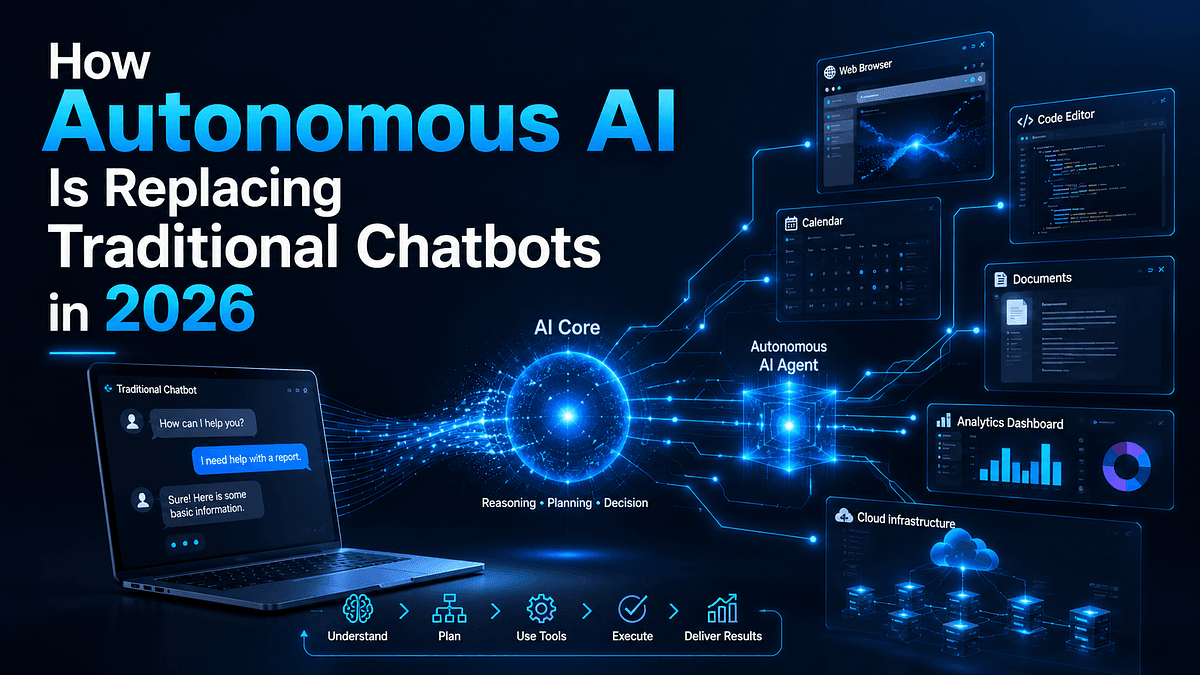
Two years ago, most enterprise software teams were still debating whether generative AI belonged inside production systems. Today that debate is over. AI agents, systems that can plan, call tools, retain memory, and act toward a goal with minimal supervision, have moved from research demos into the operating core of modern business. Gartner now expects 40 percent of enterprise applications to ship with task specific agents by the end of 2026, a jump from under 5 percent just two years earlier. The shift is not incremental. It is a rewrite of what software does for a living.
The traditional chatbot answered a question and stopped. It had no memory of yesterday's conversation, no ability to open a ticket, update a record, or check its own work. AI agents are built differently. They chain reasoning steps together, call external tools and APIs, verify their own output, and adjust course when a plan fails.
This is the core distinction behind the AI agents vs chatbots conversation dominating industry discourse in 2026. A chatbot is a single turn responder. An agentic AI system is closer to a digital employee with a defined scope of authority, a set of tools, and a persistent objective. That difference explains why so many vendors have quietly rebranded their chat interfaces as agents, even though the underlying architecture tells a different story.
The adoption curve is one of the steepest enterprise software has seen since cloud computing took hold in the early 2010s. According to Gartner, 80 percent of enterprise applications shipped or updated in the first quarter of 2026 embedded at least one AI agent, up from roughly a third in 2024. Separate research from S&P Global Market Intelligence and McKinsey puts the share of enterprises running at least one agent in live production at 31 percent, with banking and insurance leading sector adoption at close to 47 percent.
Spending has followed the same trajectory. The global AI agents market reached an estimated 10.9 billion dollars in 2026, up sharply from 7.6 billion the year before, and analysts project a compound annual growth rate above 40 percent through the end of the decade. PwC separately reports that 79 percent of companies say they are adopting AI agents in some form, and 66 percent of those adopters describe the results as measurable.
The picture is not universally rosy. McKinsey's most recent research finds that while 88 percent of organizations use AI somewhere in the business, only 23 percent have actually scaled an agentic system beyond pilot stage. Gartner projects that more than 40 percent of agentic AI projects could be cancelled before 2027 due to unclear return on investment or insufficient governance. The lesson for business leaders is straightforward: adoption is broad, but durable success still depends on disciplined execution.
Autonomous AI is no longer confined to customer support scripts. A few patterns have emerged as clear front runners.
In customer operations, agents now resolve support tickets end to end, checking order histories, issuing refunds, and escalating only genuine edge cases to a human. In software engineering, coding agents open pull requests, run test suites, and fix their own failures before a developer ever reviews the change. In finance and cybersecurity, agents monitor transaction streams and network traffic in real time, executing multi step containment decisions faster than any human analyst could react.
Sales and revenue teams have adopted agents for prospecting and outreach, with sales development agents reportedly delivering the fastest payback of any use case, at a median of roughly 3.4 months according to BCG and Forrester research. Finance and operations agents take longer to pay back, closer to nine months, reflecting the added complexity of financial controls and compliance requirements.
The productivity case for AI agents is compelling, but the deeper story is structural. AI workflow automation is shifting work away from task completion and toward task supervision. Employees increasingly manage a portfolio of agents rather than performing repetitive work themselves. McKinsey estimates that agentic systems could automate up to 30 percent of knowledge work tasks by 2030, and current deployment data already shows several hours of time saved per worker per week in live environments.
For individuals, this means the most valuable professional skill is shifting from execution to judgment. Knowing how to direct an agent, evaluate its output, and intervene at the right moment is becoming as important as the underlying technical skill itself. For businesses, the calculus is similarly clear. Companies that treat agentic AI as a governed capability, with clear ownership, audit trails, and human oversight, are far more likely to see it survive past the pilot phase.
None of this progress erases the real constraints. Agentic systems still struggle with long horizon planning, can compound small errors across multi step workflows, and require meaningful investment in observability and guardrails before they can be trusted with high stakes decisions. Regulated industries such as healthcare and government have adopted more cautiously, with production deployment rates trailing far behind banking and insurance.
Governance has become the deciding factor between agent programs that scale and those that stall. Organizations that skip investment in monitoring, human in the loop review, and clear escalation paths are the ones most likely to see their agentic AI projects cancelled, regardless of how promising the initial pilot looked.
AI agents are not a rebranding of the chatbot. They represent a genuine architectural shift toward systems that plan, act, and adapt with limited supervision, and the adoption data from 2026 confirms the shift is already well underway. The organizations pulling ahead are not necessarily the ones moving fastest. They are the ones pairing ambition with governance, treating every deployed agent as a capability that needs oversight rather than a feature that runs itself. For businesses and individuals alike, the next competitive advantage will belong to those who learn to work alongside autonomous AI systems rather than simply switching them on.