
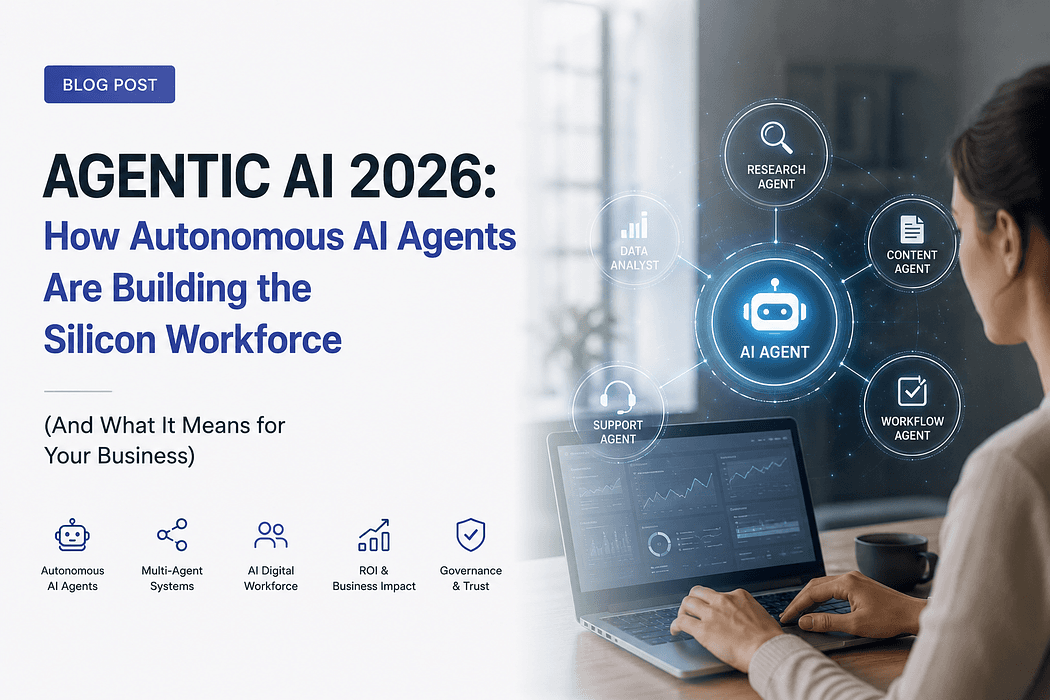
In 2026, artificial intelligence has moved beyond generating text or suggesting actions. Autonomous AI agents now plan, decide, execute multi-step workflows, and adapt in real time with minimal human oversight. This evolution toward agentic AI 2026 marks the emergence of a silicon-based workforce capable of handling complex operations across enterprises. Businesses that integrate these systems gain significant efficiency advantages, while those that delay risk falling behind in a rapidly shifting competitive landscape.
Agentic AI refers to systems designed to pursue goals autonomously. Unlike traditional AI models that respond to prompts, these agents reason through tasks, select tools, handle exceptions, and iterate until objectives are met.
AI agents versus copilots highlights a core distinction. Copilots act as assistive tools that enhance human productivity through suggestions and real-time support, such as drafting emails or summarizing documents. Agents, by contrast, operate as independent executors. They manage entire processes from start to finish, often coordinating with other agents or external systems.
This transition reflects broader industry maturity. Early generative AI focused on content creation, but agentic systems now emphasize action and outcomes. Enterprises report that agents deliver higher autonomy, enabling 24/7 operations without constant intervention.
Single agents handle isolated tasks effectively, yet 2026 trends center on multi-agent systems. These involve teams of specialized agents collaborating like a digital assembly line. One agent might research data, another analyze risks, and a third execute transactions, all while sharing context and memory in real time.
'Agent orchestration' becomes the critical enabler. It involves designing workflows, setting governance rules, and ensuring reliable handoffs between agents, humans, and legacy systems. Leading organizations treat orchestration as a core competency, akin to managing microservices in software architecture.
This approach unlocks scalability. Hierarchical or federated multi-agent setups tackle enterprise-level complexity that single models cannot manage alone. Gartner and industry reports project that by the end of 2026, 40 percent of enterprise applications will embed task-specific AI agents, up sharply from under 5 percent previously.
Practical deployments demonstrate the value. In finance, multi-agent systems monitor markets, assess risks, and execute trades autonomously while maintaining compliance. One agent tracks prices and news, another evaluates portfolio impact, and a third handles regulatory reporting.
Healthcare organizations deploy agents for patient monitoring. Agents integrate IoT data from vital signs, cross-reference lab results, and alert human teams only for anomalies requiring judgment. This reduces response times and administrative burden.
In supply chain management, agents reroute inventory dynamically during disruptions, negotiate with vendors, and optimize logistics across global networks. Manufacturing firms use them for predictive maintenance, where agents diagnose equipment issues, schedule repairs, and update production schedules without downtime.
Customer service has evolved too. Autonomous agents handle full inquiry resolution, from verification to refunds and follow-ups, escalating only complex cases. Early adopters report substantial productivity gains and improved customer satisfaction.
The silicon workforce complements human teams by taking over repetitive, rule-based, and data-intensive work. This allows employees to focus on strategy, creativity, and relationship-building.
Key advantages include:
- Accelerated operations through continuous execution without fatigue.
- Enhanced decision quality via real-time data synthesis across sources.
- Cost efficiencies from automation at scale.
- Improved scalability for handling variable workloads.
'Agentic AI ROI' stands out as compelling. Organizations with successful production deployments report average returns of 171 percent globally, reaching 192 percent in the U.S. These figures exceed traditional automation by roughly three times. Productivity increases of 20-60 percent and faster decision-making appear common among adopters.
For businesses, this translates to competitive edges in agility and innovation. The AI digital workforce enables hyper-personalization, predictive analytics, and end-to-end workflow automation that were previously impractical.
Despite strong momentum, challenges remain. Approximately 88 percent of AI agents fail to reach full production, often due to integration issues, governance gaps, or unreliable performance in edge cases. Security, compliance, and ethical oversight require robust frameworks, especially in regulated industries.
Multi-agent systems introduce complexity in debugging and accountability. Organizations must invest in orchestration expertise and human-AI collaboration models. Over-reliance on autonomy without proper safeguards can amplify errors or create blind spots.
Data privacy, bias mitigation, and alignment with business values demand ongoing attention. Successful implementations blend agentic capabilities with strong human governance rather than full replacement.
Businesses should assess current processes for agent suitability, starting with high-volume, well-defined workflows. Pilot multi-agent systems in one department before scaling. Prioritize tools supporting agent orchestration and monitor emerging agentic AI tools from established platforms.
Building internal capabilities in prompt engineering, system design, and AI management proves essential. The most important new role in 2026 may well be the AI agent orchestration specialist, responsible for integrating and optimizing these digital workers.
Leaders who redesign operations around a hybrid carbon-silicon workforce position themselves for sustained advantage. This includes upskilling teams and fostering cultures comfortable with human-AI partnerships.
Agentic AI 2026 represents more than incremental automation. It signals the construction of a capable silicon workforce that augments human potential at unprecedented scale. Companies embracing multi-agent systems, strong orchestration, and thoughtful integration will define the next era of productivity and innovation. The question is no longer whether to adopt, but how quickly and strategically to build these capabilities.