
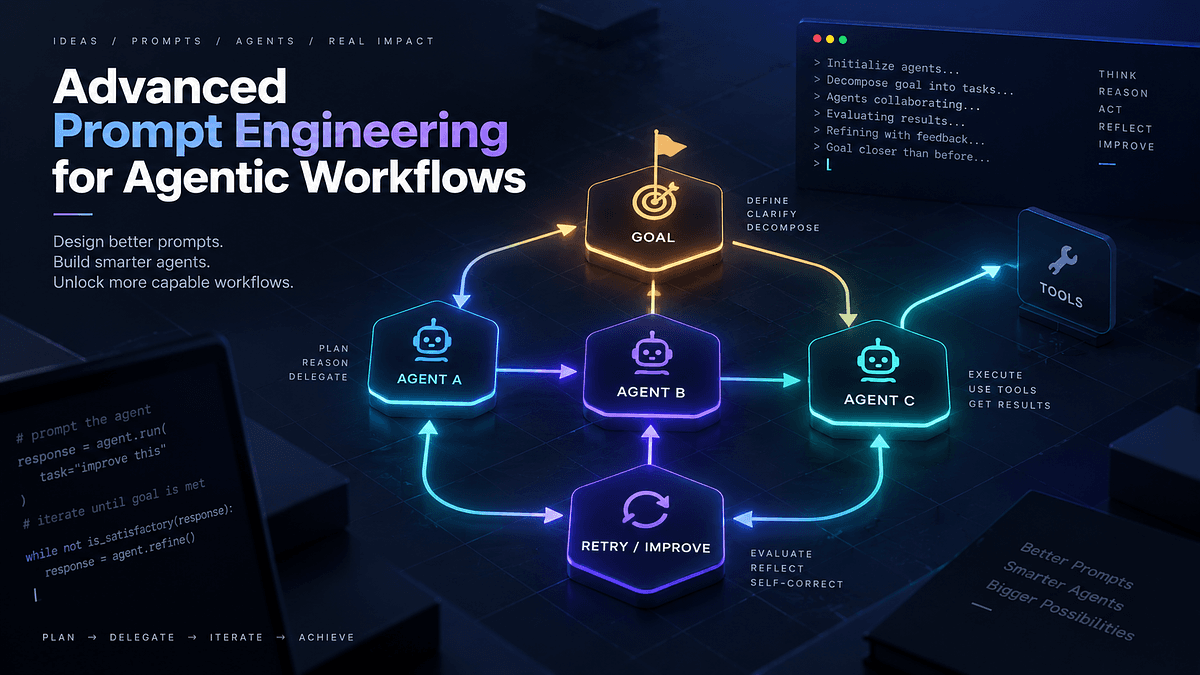
A single well-crafted instruction used to be enough to impress a room full of stakeholders. In 2026, that same instruction, dropped into a multi-agent system without structure, will quietly fall apart the moment a sub-agent needs to pass context to another, a tool call returns malformed data, or a plan needs to be revised mid-execution. Advanced prompt engineering for AI agents has moved well beyond clever wording; it now overlaps with distributed systems design, requiring engineers to think about roles, handoffs, failure recovery, and control flow as much as phrasing. This guide walks through the frameworks, structures, and failure modes that separate agent prompts that merely demo well from those that hold up in production.
Traditional prompt engineering optimizes for one input producing one bounded output, such as summarizing a document or classifying a support ticket. Agentic workflow prompting is fundamentally different because it spans multiple turns, multiple tools, and often multiple agents that never see the full picture at once. The model is no longer just answering a question; it is planning, acting, observing results, and deciding what to do next.
This shift introduces new failure surfaces that flat prompts were never designed to handle. An agent might lose track of its original goal after several tool calls, misinterpret a nested response, or hand a sub-agent a task without the context needed to complete it. Recent research on multi-agent orchestration has found that these breakdowns are rarely cosmetic; they produce incomplete, contaminated, or self-defeating instructions between agents when role boundaries are not made explicit.
Understanding this distinction is the foundation for everything that follows, because it explains why the techniques below exist as structural patterns rather than optional style choices.
The ReAct prompting framework remains one of the most durable patterns underlying reliable AI agent prompts. It structures an agent's internal process into a repeating cycle of reasoning, acting, and observing. Instead of jumping straight to an answer, the model narrates its thought process, selects a tool or action, reviews the result, and decides whether to continue or conclude.
Consider a poorly structured prompt: find the customer's account and fix their billing issue. This gives the model a goal but no visibility into how it should reason about ambiguous cases, verify its own work, or handle a missing account. A ReAct-structured version instead instructs the agent to state its reasoning before each action, specify which tool it intends to call and why, examine the returned data before proceeding, and explicitly flag uncertainty rather than guessing.
The difference in reliability is significant, particularly for tool-use prompt engineering where a single malformed API call can derail an entire task. Once an agent is reasoning in visible, inspectable steps, it becomes far easier to build the next layer: chaining multiple such steps into a coherent workflow.
Prompt chaining techniques break a large task into a sequence of smaller, verifiable steps, where the output of one prompt becomes the structured input for the next. Rather than asking a model to research a market, write a report, and format it for publication in a single instruction, a chained workflow separates these into distinct stages with clear handoff contracts.
A practical example looks like this. Stage one instructs an agent to gather and summarize the top five relevant data points on a topic, returning them as a structured list. Stage two takes that structured list and instructs a second prompt to draft narrative sections based only on the provided data points, explicitly forbidding it from introducing facts not present in the input. Stage three then instructs a formatting pass to apply house style without altering factual content.
This kind of chaining reduces the compounding errors that occur when a single, sprawling prompt tries to do everything at once. It also creates natural checkpoints where a human reviewer, or an automated evaluator, can catch problems before they propagate downstream into the final output.
Multi-agent system prompts require a different discipline than single-agent instructions because each agent operates with a limited information boundary. A common architecture assigns distinct roles such as an orchestrator, a research or search agent, a specialist writer or coder, and a reviewer, each with its own scoped instructions and access.
The orchestrator's prompt should define what each sub-agent needs to know, not what the orchestrator itself knows. This distinction matters more than it sounds. Recent benchmarking work on orchestration prompting has shown that models frequently struggle to determine what context a sub-agent actually requires, resulting in leaked distractors, dropped shared context, or instructions placed somewhere the sub-agent cannot see them.
- A clearly scoped task description limited to that agent's responsibility
- The specific inputs and context the sub-agent needs, and nothing extraneous
- The expected output format so downstream agents can consume it reliably
- Explicit boundaries on what the sub-agent should not attempt or decide
Getting this right transforms a chaotic swarm of models into a genuinely coordinated system, which sets up the next necessary layer: what happens when something goes wrong mid-task.
No agentic system performs perfectly on the first pass, which is why self-correction loop prompts have become a standard component of reliable AI agent prompts. These instructions ask the model to evaluate its own output against explicit criteria before finalizing it, catching errors that would otherwise reach a user or a downstream agent unchecked.
A basic self-correction pattern instructs an agent to complete its task, then separately review that output against a checklist covering factual grounding, format compliance, and completeness, and revise it if any criterion fails. More advanced implementations use a generator-evaluator pattern, where one agent produces a draft and a second, independently prompted agent critiques it against defined standards before it is accepted.
This adversarial evaluation step, increasingly treated as a first-class part of orchestration rather than an afterthought, catches the kind of subtle errors that a single pass rarely surfaces on its own. Once self-correction is in place, the final piece of the puzzle is making sure the agent stays anchored to the actual goal throughout a long, multi-step run.
Goal-oriented prompting keeps an agent tethered to its original objective even as intermediate steps pile up. Long-running agentic tasks are especially prone to goal drift, where an agent optimizes for completing the most recent sub-step rather than the overall outcome it was assigned.
Effective goal-oriented prompts restate the ultimate objective at key checkpoints, rather than relying on the model to retain it silently across dozens of tool calls. They also define explicit success criteria upfront, so the agent has a concrete standard to check its own progress against rather than an open-ended sense of when it is finished.
This becomes especially important in AI agent orchestration prompts that coordinate multiple specialized agents over an extended workflow, since drift in one sub-agent can quietly cascade through every agent downstream of it.
Several recurring mistakes undermine otherwise well-designed agentic systems. Vague success criteria leave agents unable to judge their own output, so instructions should always specify what a correct or complete result looks like. Overloaded single prompts that try to plan, execute, and format in one pass tend to produce compounding errors that chaining would have prevented.
Failing to define tool schemas precisely is another frequent issue in tool-use prompt engineering, since ambiguous parameter descriptions lead directly to malformed calls. Treating prompt design as static text rather than as a testable system component is perhaps the most consequential mistake, since production teams increasingly rely on repeatable evaluation and adversarial testing rather than one-off reviews to catch failures that only emerge across multi-step sequences.
Applied well, these techniques produce agents that are dramatically more reliable across research synthesis, software engineering, customer operations, and content production workflows. Structured chaining and role-scoped orchestration have allowed teams to build systems that complete work in domains where the individual practitioner had no prior specialist training, simply by decomposing tasks into well-defined, verifiable stages. Self-correction loops and clear success criteria similarly reduce the manual review burden that would otherwise be required to catch errors in autonomous output.
None of these techniques eliminate the need for ongoing evaluation. Static prompt reviews are no longer sufficient once agents operate across multi-step, multi-tool sequences, since real failures tend to emerge in interaction patterns rather than in any single instruction. Teams should budget for continuous testing, observability, and periodic prompt revision as models and tool ecosystems evolve, rather than treating an orchestration prompt as a finished artifact.
Advanced prompt engineering for AI agents in 2026 is less about finding the perfect sentence and more about designing a system of roles, handoffs, and checkpoints that can withstand the messiness of real-world execution. The ReAct framework, disciplined prompt chaining, carefully scoped multi-agent instructions, self-correction loops, and persistent goal anchoring together form a practical toolkit for building agents that behave predictably rather than impressively for a single demo. Teams looking to apply these patterns should start small, chain a two-step workflow, add a self-correction pass, and expand into full orchestration only once each layer has been tested in isolation.