
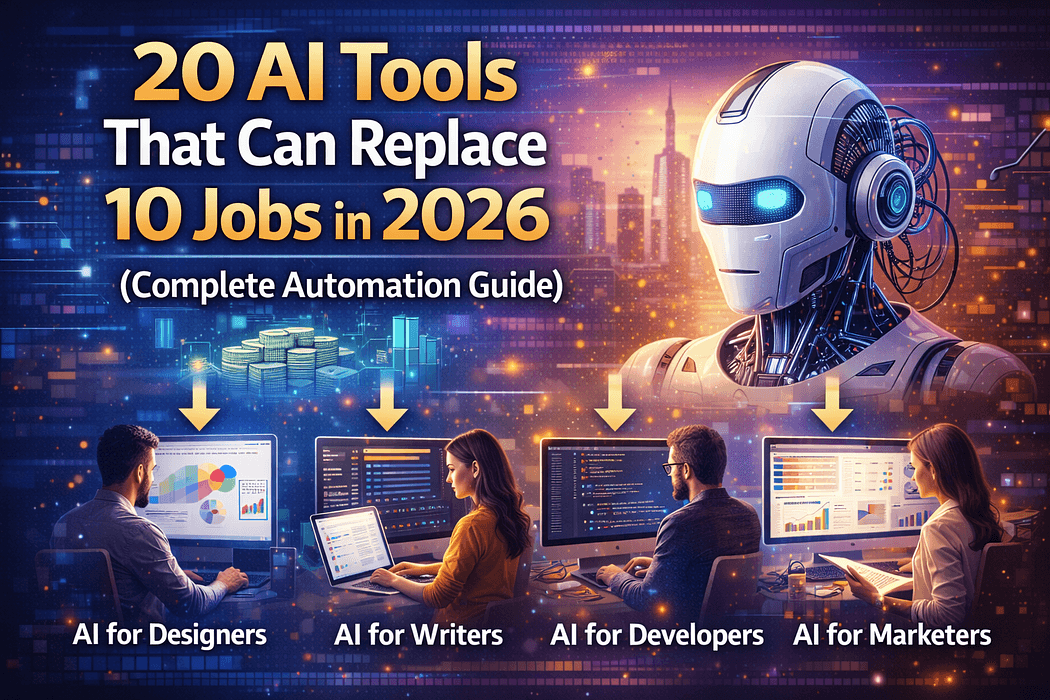
The World Economic Forum's Future of Jobs Report 2025 projects that 85 million jobs will be displaced by automation by 2030, while 97 million new roles will emerge. That net positive headline obscures a harder truth: the displacement will happen faster than the creation, and the workers most affected will not automatically transition into the new roles without deliberate upskilling. Understanding exactly which AI automation tools are disrupting which job functions is no longer optional background knowledge. It is the most important professional intelligence you can have in 2026. This guide maps 20 specific AI tools to the 10 job categories they are most actively transforming, with a clear-eyed assessment of what is being automated, what is not, and what that means for anyone working in or managing these fields.
AI tools for writers now handle first-draft generation, SEO optimization, tone adjustment, and format conversion at a speed and consistency that fundamentally changes the economics of content production. Claude and ChatGPT produce research-grounded long-form drafts in minutes. Jasper AI adds brand voice consistency and marketing-specific templates. The volume of content a single editor-in-the-loop can oversee has increased by a factor of five to ten, which has compressed demand for junior and mid-level staff writers in content marketing and publishing roles.
What AI cannot replace is original reporting, genuine subject-matter expertise, contrarian editorial perspective, and the relationship-driven content that comes from interview-based journalism. The copywriters who are thriving are those who position themselves as content strategists and AI directors rather than word producers, using AI to scale output while reserving their human judgment for the decisions that matter.
AI tools for designers have fundamentally changed who can produce visual content. Midjourney generates photorealistic and stylistically consistent imagery from text prompts that would have required a professional photographer or illustrator weeks to produce. Adobe Firefly integrates generative AI directly into Photoshop and Illustrator workflows, enabling non-designers to handle tasks that previously required specialist skills. Canva's Magic Studio automates brand asset generation across multiple formats simultaneously.
Stock photography, social media asset creation, basic illustration, and template-based design work are the most directly automated functions. Brand identity development, motion design, UX design, and creative direction requiring systemic thinking and client collaboration remain distinctly human-intensive. The AI tools replacing jobs in this category are specifically targeting the production execution layer, not the strategic and conceptual layers above it.
Video editing has historically been one of the most time-intensive creative production roles. Runway Gen-3 generates cinematic video sequences from text prompts and handles visual effects that previously required compositing specialists. Descript allows text-based video editing: delete a word from the transcript and the corresponding audio and video disappear. Opus Clip analyzes long-form video and automatically extracts, captions, and reformats the highest-engagement moments into short-form clips.
The routine post-production work of corporate video, social media content, and e-learning production is the most automated segment. Narrative documentary editing, live broadcast production, and high-end commercial post-production require the contextual judgment, storytelling instinct, and client communication that AI tools do not yet replicate. Video editors adapting to this landscape are repositioning as directors and creative supervisors overseeing AI-assisted production pipelines.
Data analysis work that once required SQL proficiency, statistical knowledge, and days of manual processing can now be initiated with a natural language question. ChatGPT's Advanced Data Analysis mode interprets uploaded datasets, runs Python analysis, generates visualizations, and explains findings in plain language. Microsoft Copilot in Excel performs the same functions inside the tool where most business analysts already work. Tableau AI generates recommended dashboards and natural language insight summaries automatically from connected data sources.
Routine reporting, dashboard creation, and descriptive analytics are the most directly affected functions. The analysts who are gaining ground are those focusing on experimental design, causal inference, strategic interpretation, and stakeholder communication: the work of deciding what questions to ask rather than mechanically answering predefined ones. The AI productivity tools in this category compress the execution time of analysis, which raises the floor for what analytical depth is expected rather than eliminating the need for analytical thinking.
AI automation tools have transformed customer service from a headcount-intensive operation into a tiered system where AI handles the majority of interactions and humans manage only escalations and complex cases. Intercom Fin resolves over 50 percent of customer support tickets without human involvement across its customer base. Zendesk AI triages incoming requests, suggests responses, and predicts escalation probability. Salesforce Agentforce deploys autonomous AI agents that handle account management tasks end to end.
Tier-one and tier-two support roles handling password resets, order status queries, refund processing, and FAQ-level information requests are the most automated. Complex complaint resolution, enterprise account management, and situations requiring empathy under high emotional stakes retain their human value. The future of AI jobs in customer service is increasingly in AI training, quality assurance of AI responses, and handling the edge cases that define a brand's reputation.
AI tools for developers have restructured the software development profession more rapidly than any previous technology shift. Claude Code operates as an autonomous coding agent that writes, tests, debugs, and refactors code across entire codebases from natural language instructions. Cursor's context-aware code editor understands the full project structure rather than just the open file, producing suggestions that account for existing architecture, naming conventions, and dependencies. GitHub Copilot automates the routine function-level code generation that previously occupied the majority of a developer's active keyboard time.
Over 56 percent of engineers report completing 70 percent or more of their coding with AI assistance, according to the Pragmatic Engineer's 2026 survey. The implication is not mass developer unemployment but a dramatic shift in what developers are paid to do: less syntax production, more system design, architectural decision-making, code review, and requirement specification. Junior developer roles that consisted primarily of writing boilerplate are the most affected. Senior roles focused on technical leadership have become more valuable.
AI tools for marketers now span the full campaign lifecycle. HubSpot's AI features automate email sequences, lead scoring, content personalization, and reporting. AdCreative.ai generates high-converting ad variants at scale, running multivariate tests that would require weeks of manual creative production to replicate. Perplexity AI accelerates market research and competitive intelligence by synthesizing current information from live web sources into structured briefs in seconds.
Campaign execution, A/B testing management, performance reporting, and standard content production are the most automated marketing functions. Brand strategy, creative direction, audience insight development, and partnership negotiations retain their human premium. Marketing professionals who understand both the strategic layer and how to direct AI tools effectively are commanding higher compensation than their pre-AI counterparts.
DeepL's neural translation quality for common European language pairs has reached a level where professional post-editing time has decreased by 60 to 80 percent on standard commercial documents, according to industry benchmarks published by the Translators Association of Europe. ElevenLabs' dubbing system automatically translates and re-voices video content in over 30 languages with synchronized lip movement. Gemini handles multilingual document generation and contextual translation for enterprise workflows.
High-volume document translation, localization of standard marketing copy, and subtitle generation are the most automated language work categories. Literary translation, legal and medical translation requiring certified accuracy, interpretation in high-stakes negotiation and legal settings, and cultural consulting work requiring deep contextual judgment remain domains where human expertise commands significant premium.
The administrative function has been one of the most directly transformed by AI work automation tools. Fathom AI automatically records, transcribes, and summarizes meetings with action items extracted and distributed within 30 seconds of call completion. Zapier AI agents handle email triage, calendar management, document routing, and CRM data entry autonomously. Microsoft Copilot drafts correspondence, prepares briefing documents, and manages inbox prioritization with full access to organizational data.
Scheduling, data entry, standard correspondence drafting, and meeting documentation are the most automated administrative functions. Senior executive assistants who manage complex stakeholder relationships, exercise discretionary judgment on sensitive communications, and provide strategic counsel to executives are insulated from this automation wave. The administrative roles most at risk are those defined entirely by task execution without the relationship and judgment dimensions.
Financial AI automation tools are restructuring both accounting and investment analysis. Intuit Assist in QuickBooks handles bookkeeping, expense categorization, tax preparation, and financial reporting for small and medium businesses with minimal human oversight. Bloomberg's AI-powered terminal features summarize earnings calls, generate financial model inputs from natural language queries, and flag anomalies in financial data in real time. Kensho, the financial AI platform owned by S&P Global, analyzes the market impact of macro events and produces research reports that previously required junior analyst teams days to complete.
Routine bookkeeping, standard financial reporting, first-pass earnings analysis, and compliance data preparation are the most automated functions. Strategic financial advisory, M&A due diligence, complex tax structuring, and the relationship-intensive work of investment banking retain their human value. Financial professionals with strong quantitative skills who also understand how to design, interpret, and quality-check AI-generated analysis are the most defensible practitioners in this field.
Looking across all ten job categories, a consistent pattern emerges: AI tools replacing jobs are almost exclusively targeting the execution layer of professional work, specifically the tasks that are high-volume, rule-based, and do not require contextual judgment, client relationships, or creative direction. The strategic, relational, and advisory layers of every one of these roles are gaining value as the execution layer is commoditized.
The most useful reframe is not job replacement but task replacement within jobs. A copywriter who spends 70 percent of their time on first drafts and 30 percent on strategy will find the first-draft time automated. The question is whether they redirect that recovered time toward higher-value strategic work or whether their employer simply reduces headcount by 70 percent. That outcome is a management decision as much as a technological one, and it is why understanding which of your tasks are automatable is the essential first step in a proactive career response.
The 20 AI automation tools covered in this guide are not hypothetical future technologies. They are in production, they are widely deployed, and their adoption curve is steepening. The professionals who are navigating this transition most successfully are those who treat AI tools as amplifiers of their judgment rather than threats to their employment, and who proactively identify which tasks within their roles are most automatable and reposition their professional value around the work that remains distinctly human.
The single most actionable response to this landscape is to audit your current role against the task automation patterns described here. Identify the percentage of your working week spent on execution tasks that match the automated categories, build fluency with the AI tools relevant to your field, and invest in the strategic, relational, and advisory dimensions of your work that remain beyond the current automation frontier. The future of AI jobs belongs to the professionals who direct these tools rather than compete with them.