
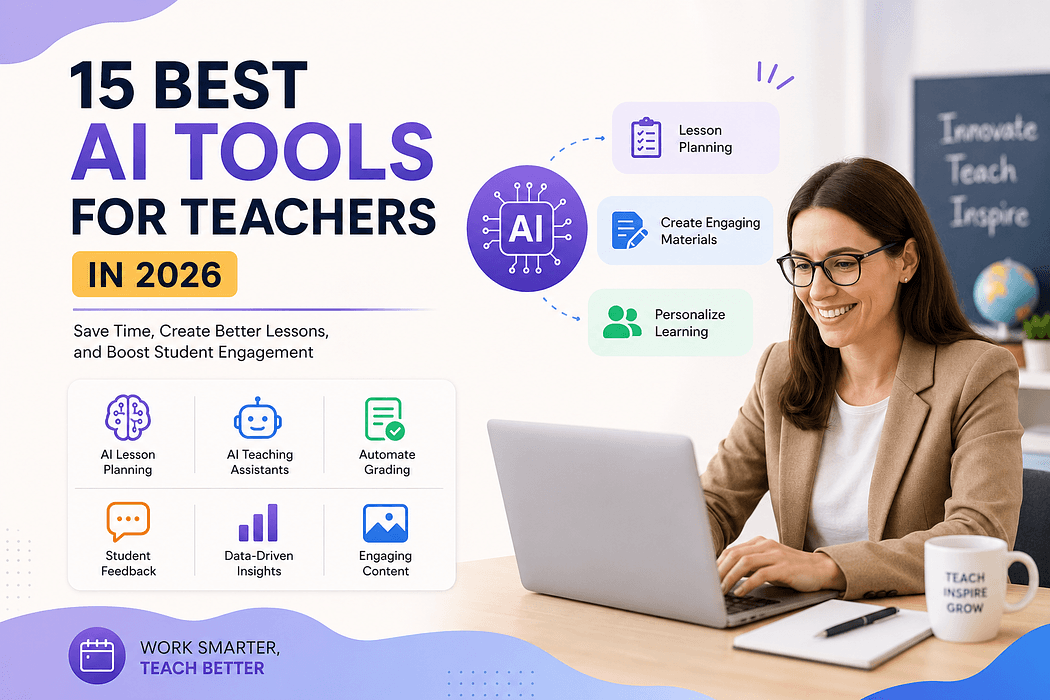
Teachers in 2026 face increasing demands on their time while striving to deliver personalized, engaging instruction. Artificial intelligence has evolved from experimental novelty to essential classroom support. The best AI tools for teachers help automate routine tasks, differentiate instruction effectively, and create dynamic learning experiences that keep students motivated.
This comprehensive guide explores leading educational AI tools that address core challenges in modern teaching. These solutions range from comprehensive platforms to specialized assistants, each offering distinct advantages for lesson planning, classroom management, assessment, and student engagement.
By 2026, a significant majority of educators incorporate AI into daily workflows. Teachers who use these tools regularly report saving an average of several hours per week, allowing more focus on meaningful student interactions. AI supports personalization at scale, adapts content to diverse learning needs, and provides immediate feedback that traditional methods cannot match efficiently.
The following tools represent the most impactful options available, selected for their proven classroom utility, reliability, and teacher-friendly design.
MagicSchool AI stands as one of the most popular all-in-one solutions, featuring over 80 specialized tools for educators. Teachers use it to generate lesson plans aligned with standards, create differentiated worksheets, develop rubrics, draft parent communications, and build assessments quickly.
Features include text levelers for adapting reading materials, quiz generators, presentation creators, and custom chatbots for student support. Educators appreciate its focus on privacy and district-level controls. A typical use case involves inputting a topic and grade level to receive a complete lesson plan with activities, discussion prompts, and assessment ideas in minutes.
This platform suits busy teachers across grade levels who want a centralized hub for planning and instruction. While powerful, outputs benefit from teacher review to ensure alignment with specific classroom dynamics.
Brisk Teaching integrates directly into Google Workspace and Microsoft tools, making it seamless for educators already using these ecosystems. The Chrome extension allows quick generation of lesson plans, quizzes, rubrics, and differentiated materials from existing documents or web content.
Key strengths include personalized feedback tools that embed comments in student work, writing process inspection for detecting revisions, and content releveling. Teachers report significant time savings on feedback and material adaptation. It works particularly well for creating differentiated versions of the same lesson for various reading levels or language needs.
Eduaide.ai offers strong content generation capabilities with emphasis on multilingual support and standards alignment. Teachers value its tools for creating learning objectives, activities, and assessments tailored to specific subjects and student populations.
Curipod excels at transforming simple prompts into interactive, engaging slide-based lessons. It generates polls, drawing activities, word clouds, discussion prompts, and AI-powered feedback mechanisms that keep students actively involved.
Teachers input a topic or learning objective, and Curipod produces a complete teacher-paced lesson with built-in engagement features. Real-time insights help identify learning gaps during class. This tool shines in subjects requiring discussion or visual thinking, such as science experiments, historical debates, or literature analysis.
Differentiation remains a major time challenge for teachers. Diffit addresses this by adapting any text, article, or video content to different reading levels while maintaining core concepts. It automatically generates summaries, vocabulary support, comprehension questions, and activities.
A common workflow involves pasting a complex primary source document and selecting appropriate reading levels for various students. The tool supports inclusive classrooms by ensuring all learners access grade-level content at accessible complexity.
Visual learning plays a crucial role in student engagement. Canva's AI-powered Magic Studio helps teachers create professional presentations, infographics, worksheets, and interactive visuals without design expertise. Features include magic write for text generation, background removal, and image enhancement.
Teachers use it to produce eye-catching lesson materials, project templates, and visual aids that make abstract concepts more concrete. The education-specific version offers additional collaboration features suitable for classroom projects.
General-purpose AI models have become highly specialized for education. Google Gemini integrates deeply with Google Classroom and Workspace, offering research capabilities, content generation, and document analysis. It excels at pulling current information and creating structured educational content.
Microsoft Copilot provides similar strengths within the Microsoft 365 environment, with strong capabilities in data analysis for grading trends and presentation creation.
Developed by Khan Academy, Khanmigo functions as both a teacher assistant and student tutor. It offers guided lesson planning, activity suggestions, and Socratic-style questioning that promotes deeper thinking. Teachers use it for progress monitoring and generating personalized learning pathways.
This Google tool creates interactive study guides, podcasts, and summaries from uploaded materials. Teachers upload textbooks, lecture notes, or research papers to generate engaging audio overviews or FAQ documents that students find more accessible than traditional readings.
AI grading assistants like Gradescope and specialized platforms streamline evaluation of assignments, particularly those with structured responses. These tools provide consistent feedback while flagging areas needing human attention.
For interactive assessment, ClassPoint enhances PowerPoint presentations with real-time quizzes, gamification, and analytics that help gauge understanding instantly.
Perplexity AI serves as an excellent research companion, providing cited, up-to-date information that teachers can incorporate into lessons with confidence. ChatGPT remains versatile for brainstorming, writing prompts, and creative task generation when used thoughtfully.
Nearpod offers AI-enhanced interactive lessons with virtual field trips and formative assessments. Tools like these continue evolving rapidly in 2026.
The primary advantages include substantial time savings on administrative and planning tasks, enabling teachers to invest more energy in relationship-building and complex instruction. Personalized learning becomes feasible at scale as AI adapts content to individual needs. Student engagement increases through interactive formats and immediate feedback loops.
Data from various implementations shows improved learning outcomes, higher completion rates, and better identification of struggling students. Teachers report reduced burnout and greater creativity in lesson design.
While powerful, these tools work best as assistants rather than replacements for teacher judgment. Outputs require review for accuracy, bias, and alignment with educational standards. Privacy concerns demand careful selection of FERPA-compliant platforms, especially when handling student data.
Over-reliance on AI may reduce opportunities for developing certain skills in both teachers and students. Effective implementation requires training and clear school policies. Not all tools suit every teaching context or subject area equally.
Begin with one or two tools addressing your most pressing needs, such as lesson planning or differentiation. Most platforms offer free tiers sufficient for individual teachers to experiment. Professional development focused on prompt engineering maximizes value from these systems.
The best AI tools for teachers in 2026 transform challenging aspects of the profession into manageable, creative opportunities. By handling routine tasks efficiently, they free educators to focus on what matters most: inspiring and guiding students. As these technologies mature, thoughtful integration will define excellent teaching practices.
Educators who embrace these tools strategically position themselves and their students for success in an increasingly AI-influenced world. The future of education combines human connection with intelligent assistance, creating richer learning experiences for all.